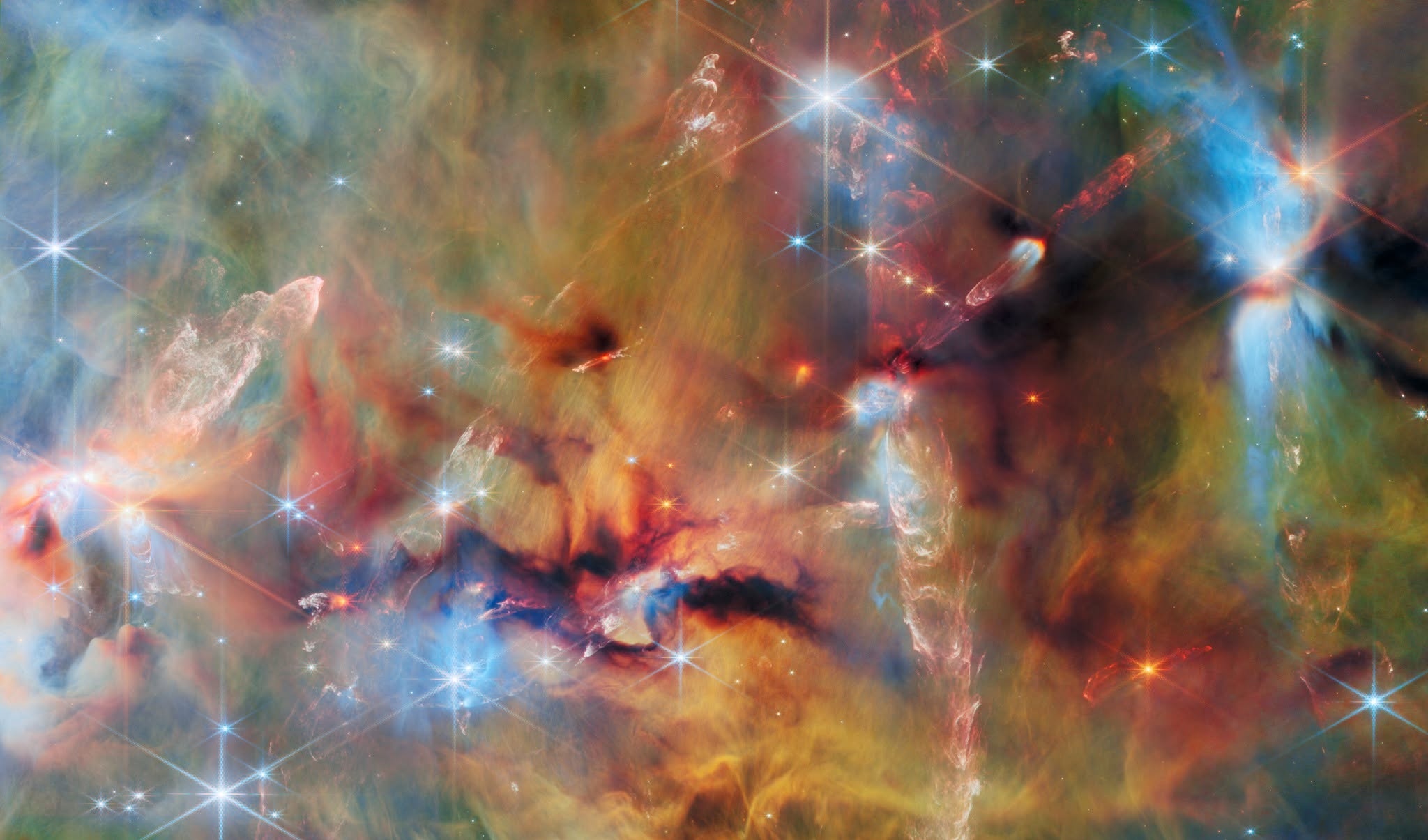
Beyond the Orion Nebula is a long and massive filament of cold gas and dust, divided into four parts and collectively called the Orion Molecular Clouds. This image, captured by Webb, shows just a small portion of one of the clouds.
Every stage of star formation — from the youngest stellar embryos, to protoplanetary discs, to newly-minted pre-main sequence stars — is contained within this scene (captured by Webb’s Near-Infared Camera) which stretches 150 light-years across.
The intense star-forming activity has produced an impressive display of billowing outflows and sparkling stars atop swirling layers of gas and dark, obscuring clouds. Only in the infrared do we see protostars begin to shine out from the cocoons of dust in which they are born.
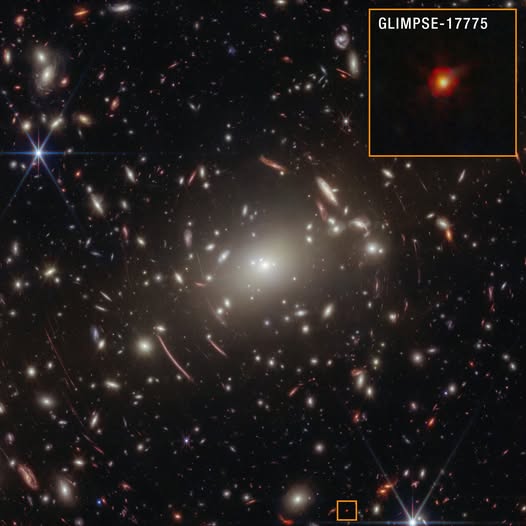
This is the strongest evidence yet for ‘black hole stars’!
Soon after the NASA/ESA/CSA James Webb Space Telescope began its observations, it discovered a mysterious type of object in the early Universe known as little red dots (LRDs). What could they be?
Recently, Webb captured the deepest spectrum to date of a little red dot known as GLIMPSE-17775. These data point to it being a black hole star!
A black hole star is a rapidly accreting black hole enveloped in a dense cocoon of gas, which is reprocessing the light emitted from near the black hole and producing the features seen in the spectrum.
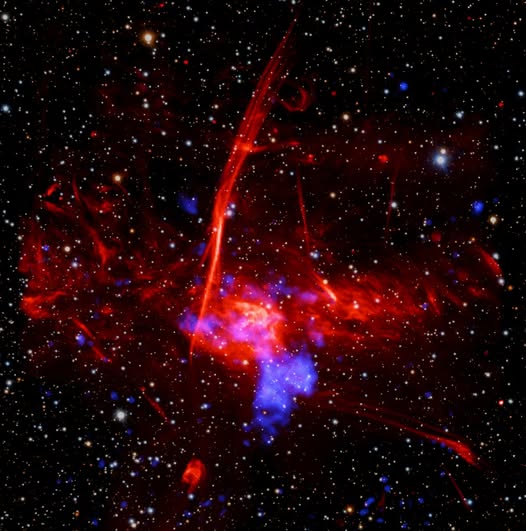
Astronomers may have found a supernova remnant in an intriguing neighborhood in the middle of our galaxy. If confirmed, it would be one of the closest ever discovered near the supermassive black hole at the center of the Milky Way galaxy. It’s expanding at about 3.2 million kilometers per hour (2 million mph) and is at least 1,700 years old.
hopefully sometime soon they will use the JWT to look for planet X. Because its basically the only one that can effectively look for it.
Planet X is roughly 40,000km in diameter but is 70B km out. For context, voyager isnt even close to halfway there. Because it is so far out it is VERY dim.
Dwarf planet Ceres is close to the same size in the sky relatively (0.4arcsec vs 0.15arc) so a relatively standard telescope can see it (under 10”) ceres has a aparent magnitude of +6.5
Planet X will be +25 (the bigger the positive number, the dimmer) meaning basically only JWT can be able to find it. Thats +100mil x dimmer than the naked eye can see (about what Ceres is at +6.5) Hubble and some super large land telescopes MIGHT be able to find it, but only using ultra long exposure and locking onto the exact location. Cant do that unless you know where it is.
 This is the strongest evidence yet for ‘black hole stars’!
 Soon after the NASA/ESA/CSA James Webb Space Telescope began its observations, it discovered a mysterious type of object in the early Universe known as little red dots (LRDs). What could they be?

 is a rapidly accreting black hole enveloped in a dense cocoon of gas, which is reprocessing the light emitted from near the black hole and producing the features seen in the spectrum.