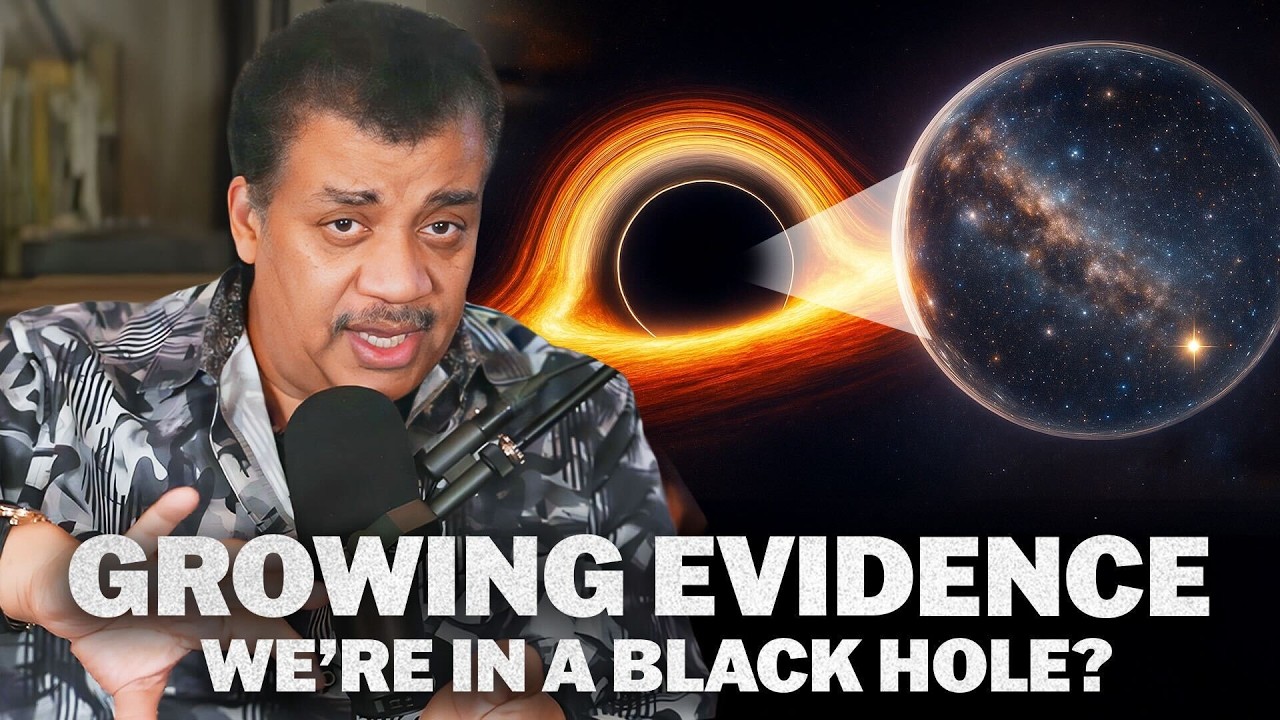
So the universe existing inside a massive black hole isn’t a new new idea, though echoes of it are almost mainstream at the moment. (Maybe that’s just my algorithm.) I don’t really understand the idea. That’s not exactly what this post is about.
The idea does suggest that there are multiple universes beyond our event horizon though. And if we give credence to that, it stresses provincial views of God. If the immensity of the universe hasn’t already done that…
Does God see beyond event horizons? Are there individual Gods for each universe? If so, are they exact clones or do they put their own spin on things? It gets messy, in my small mind at least. Imma take a chill pill…
A physicist has proposed a mind-bending new idea: what if time, not space, is the true foundation of our universe—and not just one direction of time, but three? According to Gunther Kletetschka from the University of Alaska Fairbanks, time may have three dimensions, while space could simply be a byproduct. Instead of the classic four-dimensional spacetime we’ve long accepted, this theory envisions reality built on a six-dimensional fabric: three time dimensions and three space dimensions.
Think of it like a painting: traditional physics says space is the canvas and time flows across it. Kletetschka flips that—time is the canvas, and space is just the paint. His work builds on previous theories that explored three-dimensional time but were mostly theoretical. His version, however, claims to make real-world predictions, including accurately calculating the masses of known particles like electrons and quarks.
Three-dimensional time means there could be other “directions” of time—like stepping sideways into a different outcome of the same day, rather than just moving forward. But don’t worry: Kletetschka’s model still respects cause and effect. He believes this idea could even help scientists finally unify quantum mechanics and gravity into a long-sought “theory of everything.”
While intriguing, it’s worth noting that this theory hasn’t yet been widely accepted. It was published in a lower-profile journal and hasn’t undergone rigorous peer validation. But if it holds up, it could completely reshape how we think about the universe—and ourselves.
Three-Dimensional Time: A Mathematical Framework for Fundamental Physics
Quantum entanglement is a phenomenon so strange that even Einstein doubted it. When two particles become entangled, they form a deep and invisible connection. No matter how far apart they are pulled even across galaxies, any change in one instantly affects the other. This reaction happens faster than the speed of light and appears to ignore distance altogether. Scientists have tested this repeatedly and found it to be real. What makes it even more mysterious is that no signal seems to travel between them. This challenges our understanding of space and time. Some researchers believe it could reveal a hidden structure beneath our universe. Others think it may one day be used to create ultra-secure communication or even teleport information. Whatever the answer is, entanglement shows that reality is far more interconnected than it seems.
Meet S4714, the fastest star ever discovered, and it is racing around the Milky Way’s supermassive black hole like nothing we have seen before. This record-breaking star was spotted near Sagittarius A*, the massive beast sitting at the centre of our galaxy that weighs about four million times the mass of our Sun.
At its peak speed, S4714 hits an insane 15,000 miles per second or 24,000 kilometres per second. To put that into perspective, this speed is enough to travel from Earth to the Moon in just 16 seconds. That is not science fiction, it is real data from the European Southern Observatory’s Very Large Telescope.
But it gets even crazier. S4714 doesn’t follow a smooth circular path. Its orbit is sharply elliptical, diving extremely close to the black hole before flinging itself back out in a wild loop. It is one of a special group of stars called S stars, which dance around the black hole under the grip of its intense gravity.
Even wilder, S4714 might be part of a hypothetical group known as squeezars. These are stars that pass so close to a black hole they get stretched and heated by its tidal forces. Over time, they begin to change shape and structure, pulled and reshaped by gravity like cosmic clay.
This star, along with its fast siblings S4711 through S4715, is helping scientists test Einstein’s general relativity, map how gravity behaves near black holes, and understand the extreme physics happening in the heart of our galaxy.
The universe just keeps getting stranger and faster.
talking about einstein it’s crazy to me how far apart actual bonafide geniuses come out of the human race.
I mean newton is probably the smartest human to have ever existed (so far) but the fact we can talk about the smartest of us on one hand is a bit depressing.
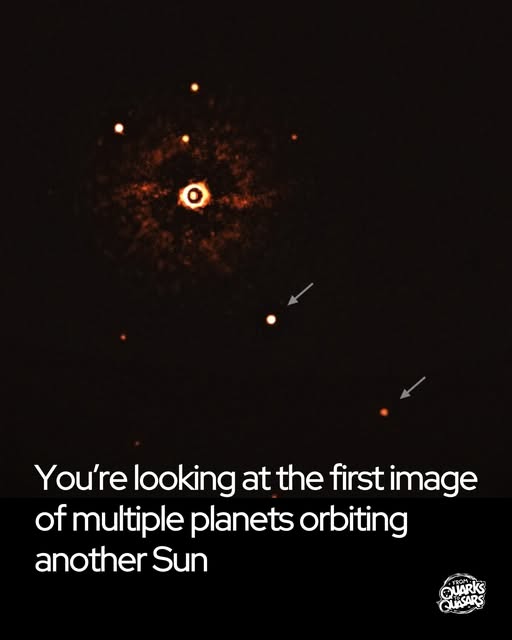
This is the first time we’ve ever photographed a solar system like our own.
The stunning image – captured by the SPHERE instrument on the European Southern Observatory’s Very Large Telescope – shows not one, but two giant exoplanets orbiting a young, Sun-like star named TYC 8998-760-1, located about 300 light-years away.
The two bright dots near the center and bottom right of the image are TYC 8998-760-1b and TYC 8998-760-1c – the first time astronomers have directly imaged multiple planets orbiting a star similar to our own Sun.
To capture this view, scientists used a coronagraph to block the overwhelming glare of the star, revealing its faint planetary companions. The surrounding bright and dark rings are optical artifacts – not features of the star system.
Other bright dots in the frame are distant background stars, ruled out as imposters by tracking their movement over time.
It’s a glimpse into another solar system, and a major milestone in the search for worlds beyond our own.
Could your thoughts be powered by quantum physics?
A bold and controversial theory known as Orch-OR (Orchestrated Objective Reduction) is shaking up how we understand consciousness. Emerging research suggests that tiny protein structures inside brain cells called microtubules may exhibit quantum vibrations, potentially playing a key role in how we think, feel, and perceive reality.
Published in Physics of Life Reviews, the study dives into the possibility that these quantum effects enable non-local processing in the brain. In simpler terms, it means parts of your brain might be communicating in ways that aren’t limited by traditional electrical or chemical signals almost like quantum computers sharing data across invisible channels.
Though still theoretical and far from proven, this research sparks deep questions. Could quantum biology be the missing link in explaining consciousness the thing science has struggled to define for decades? Could your mind be more than just neurons firing? Could it be tapping into the very fabric of the universe?
Skeptics caution that the brain is a noisy, warm place conditions not ideal for delicate quantum states to survive. But if future studies confirm even parts of this theory, it could redefine our understanding of life, thought, and even reality itself.
Whether it’s ultimately validated or not, Orch-OR opens a door to explore the mysterious crossroads between physics, biology, and the human mind.
For years, astronomers knew something wasn’t adding up. When they added up all the ordinary matter — the atoms that make stars, planets, and people — they kept coming up short. About 40% of it was missing. Not dark matter, not dark energy — just regular matter that somehow vanished.
Turns out, it wasn’t missing. It was just hiding — spread out as thin, hot gas between galaxies, invisible to traditional telescopes.
So how did scientists spot it?
They used something called Fast Radio Bursts — short, intense flashes of radio waves from deep space. As these bursts travel through the universe, they slow down ever so slightly when passing through matter. By measuring that delay, researchers figured out just how much stuff was in their path. And boom — the numbers lined up.
To double-check, another team used X-ray space telescopes to look at a massive structure called the Shapley Supercluster. They found a giant thread of hot gas stretching 23 million light-years — exactly the kind of structure simulations had predicted decades ago.
So, yes — the models were right all along. We just needed the right tools to prove it.
This discovery doesn’t just solve a cosmic mystery — it helps us better understand how the universe formed, how galaxies evolved, and how everything fits together.