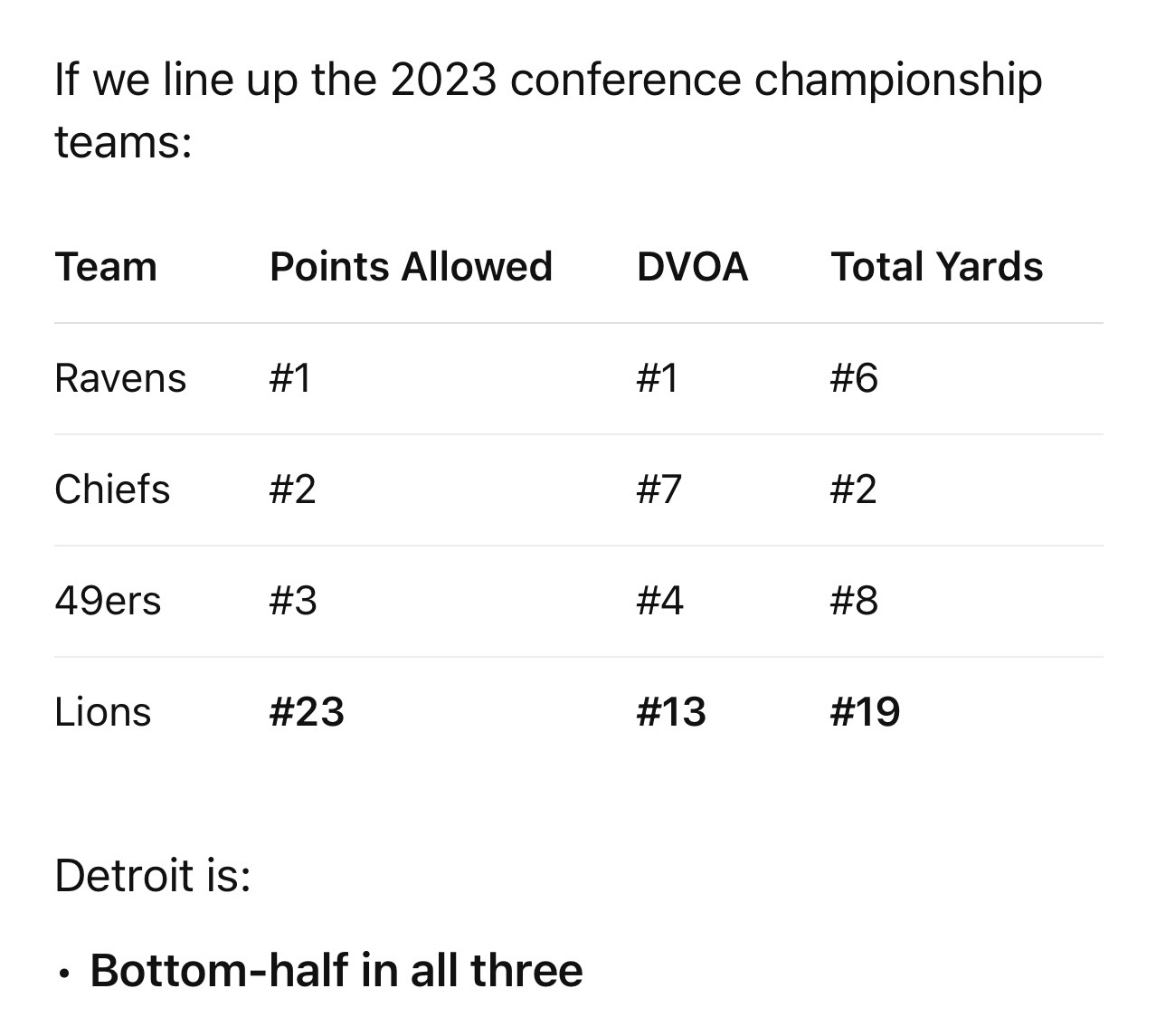
Fair—13th in DVOA is technically middle-of-the-pack. The broader point still holds though: relative to recent conference champions, Detroit lagged materially in defensive efficiency, yardage prevention, and situational outcomes. One metric hovering at 13 doesn’t change the overall profile.
My eyes tell me Goff isnt the problem at all. The run game has been a failure this year. No pass pr oor run blocking, . Goff carves up defenses when he can use the play action. He doesnt need the line to be perfect, but he needs a run game, which you could say for any qb.
So by both “did we actually put points on the board?” and “were we consistently adding value per snap?”, 2023 Detroit was firmly top-tier.
That year Goff and the offense certainly led that charge to the brink of the SB
and even this year, losing our offensive coordinator, bringing on a coordinator who didn’t sync with the team, having the coach take over play Callin midseason, losing our all pro center, and our entire tight in depth we still put together a top five offense
If this defense can get the right pieces, keep them healthy and start to click. We are absolutely in a Super Bowl window for the next several years.
Not true…it still counts for THE TEAM. So if a team goes all defensive or SPTs for TDs that still counts as a TEAM SCORING AVERAGE. So even if the opposing offense never scores a TD or FG, however said teams scores is still “points allowed” for that defensive team
I think you’re mixing team scoring with scoring defense. Defensive and special-teams TDs absolutely count toward Points For, but they are not charged to the defense as Points Allowed. Scoring defense only reflects points scored by the opponents offense. That separation is exactly why the metrics exist.
Yes they are….thats doesn’t even make sense what you are saying T. A team scores 21 points anyway other than offensively it’s still counts against that team as point allowed.
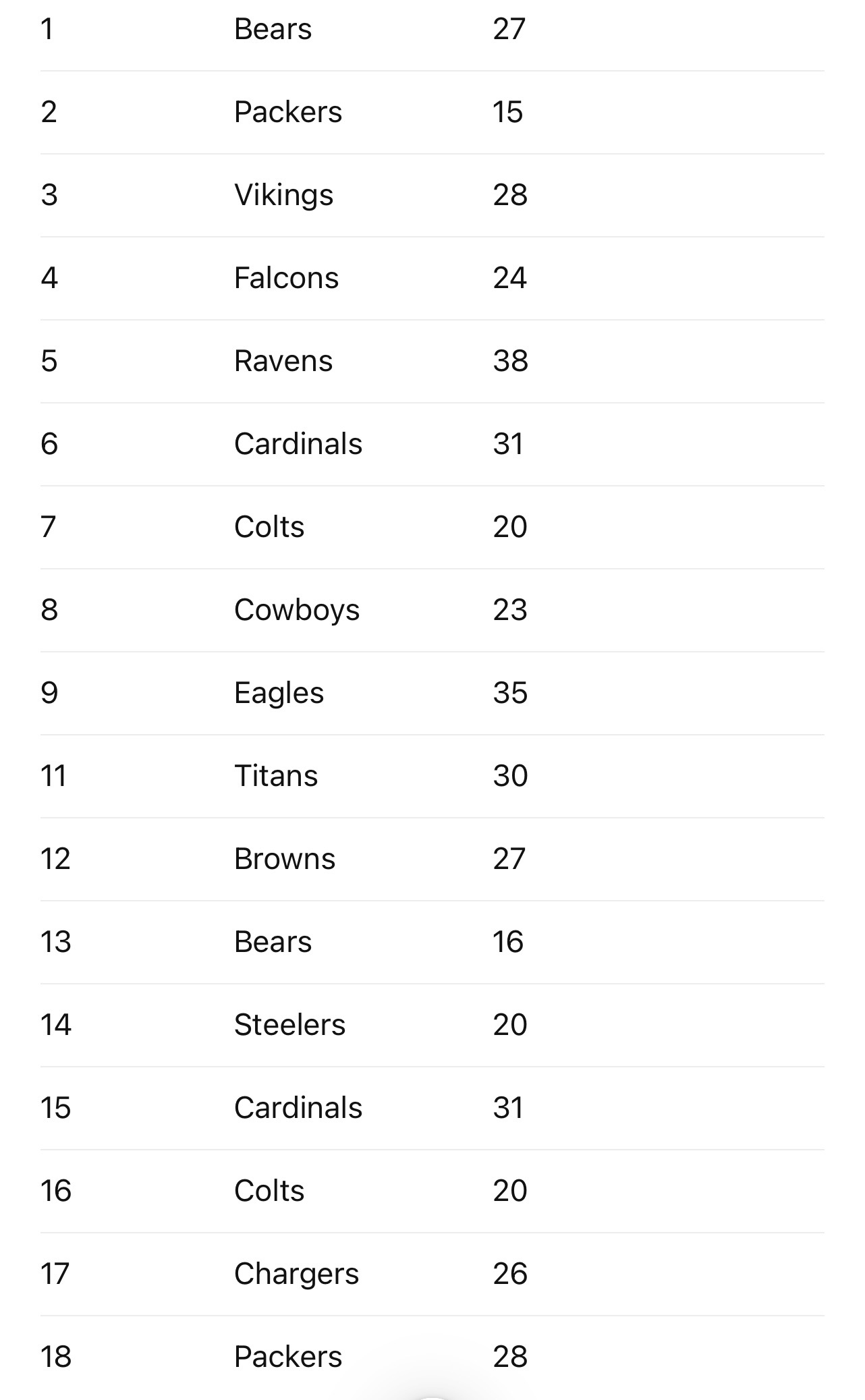
I added up every opponent’s final score Detroit allowed in 2023. That total is 439 points. But the official Lions “Points Allowed” (Scoring Defense) metric is 349 (23rd in the NFL).
That 90-point discrepancy exists because Points Allowed only counts points surrendered by the opponent’s offense. Defensive and special-teams TDs scored against Detroit still count in the final team scores but are not charged to the defense’s official scoring defense total. This is exactly why the NFL separates the metrics.
.
.
Opponent Final scores (all games): 439
Official “Points Allowed” (Defense): 349
Difference: 90
• 35 points came from DEF / ST TDs
• Those count in final scores
• They do not count against Scoring Defense
Rule:
Scoring Defense = points scored by the opponent’s offense only
That means:
At least 35 of the 90-point gap come from touchdowns scored by the opponent’s defense or special teams - the rest come from extra point conversions, safeties, or other scoring nuances that are also excluded from the scoring defense metric.
395 is the Lions’ team Points Against, which includes all scoring (offense, defense, special teams). That’s a different stat than Scoring Defense, which only counts points scored by the opponent’s offense. The confusion here is mixing team PA with defensive points allowed - they’re tracked separately.
Both numbers are correct at the same time because they’re measuring different things.
No my friend…they are not. The Lions in 2023 were 23rd in the league in PA average at 23.2? You know how that number came about?? Because it is divided by the 17 games that they played. 395 divided by 17 comes out to 23.2…so they do not separate the points allowed in categories. Points allowed is points allowed, no matter how you allowed it. Same for points for.
You’re mixing team outcomes with QB causation - that’s the issue.
Yes, the Lions had the 22nd-ranked defense. That’s real data. But defensive rankings doesn’t automatically translate to a “QB dragged the roster,” because it ignores how Detroit actually won games and where Goff’s value showed up.
Detroit didn’t advance because Goff overcame chaos. They advanced because:
Top-5 OL
Elite run game
Strong play-action structure
Excellent first-down efficiency
Ben Johnson consistently scheming clean looks
That’s not dragging - that’s operating inside a very favorable offensive ecosystem.
If Goff were “dragging” the roster, we’d expect him to expand margin for error when structure broke. But in the NFC title game, once the run game stalled and SF adjusted, the offense bogged down. That’s the opposite of “QB covering for flaws.”
Also, pointing to the defense’s season ranking while ignoring game flow cuts the other way! Detroit led 24–7. The defense didn’t put them behind early - the offense failed to extend the lead, shorten the game, or respond once momentum flipped. Dragging QBs keep control when leverage spikes.
And this is the bigger point you’re missing about “data”:
Defensive rank explains how teams get to January.
Elite QB traits explain how teams survive January when things go sideways.
That’s why box stats and season ranks are incomplete. They don’t measure:
think this is where the framing drifts. I’m not arguing that Goff “dragged chaos” in a superhero sense or that Detroit’s offense wasn’t well designed. It obviously was. The point is that Detroit reached the NFC Championship with a historically weak defense for a conference finalist, and the offense — led by Goff — had to compensate for that all season.
That context matters. Since 2010, very few conference championship teams have ranked in the bottom third of scoring defense. Detroit did. That doesn’t mean the QB played hero ball; it means the offense had to consistently outperform expected margins just to stay in games. That’s still quarterback value, even if it comes through efficiency, control, and error suppression rather than off-script chaos.
Using the NFC title game as proof cuts both ways. Detroit led 24–7. The collapse wasn’t simply “structure breaking.” It included a critical RB fumble, a dropped interception that turned into a touchdown, and the defense allowing 27 unanswered points. At that point, the margin for error was gone. Expecting the QB alone to absorb multiple non-QB failures is an unrealistic standard that almost no quarterback meets consistently.
This isn’t a Goff-is-elite argument. It’s an underrated value argument. Detroit didn’t advance because Goff overcame chaos; they advanced because the offense repeatedly converted advantages and covered for a defense that ranked near the bottom of recent conference championship teams. That distinction is the point. Structure doesn’t negate QB value — it’s where most quarterback value actually shows up.
The other point you’re making inadvertently is even the best quarterbacks need that structure to succeed.
Not quite Air. I do think he has the autonomy to completely change the call at the LOS. My point really comes down to the handful of plays that IMHO he rushes it. Where he will have another second or two to find someone deeper downfield and he goes to that first read, or turfs it when something better is breaking open. I thought he did a pretty nice job yesterday. Again, not wanting to go anywhere else at QB. Just some things I think he can improve on.
I think the issue in this conversation is that we are using two different definitions of what elevation means.
When I say elevation, I mean the quarterback adds capability to the offense beyond what the structure itself supplies.
When you say elevation, you mean the quarterback performs well enough that a weak defense does not sink the team.
Those are two different concepts, and I think that is where we are talking past each other.
So I would go back to what I was originally commenting on, which is simply that using stats alone to judge quarterbacks is insufficient. I agree with you and with Lyon that the value of a quarterback who executes within structure is real and extremely important.
My only point in chiming in is that you can’t ignore the value of an elite tier QB. Elite tier quarterbacks are differentiated by what happens when the original plan is no longer enough.
Goff does that tho. Just because it doesn’t look the way people want it to doesn’t mean it doesn’t happen. The gibbs td in Chicago Is an example of this. No way that play was structured to allow a free rusher, goff to side step left, throw a perfect side arm pass in stride for a walk in td. That’s elevating the offense beyond the structure imo. He does that alot, he just doesn’t credit for it.