I think teams that make it clear they are willing to trade the player don’t offend the players.
The Chiefs put the tag on Snead last year and gave him permission to negotiate a deal with a team willing to trade for gim.
Titans gave them a 2nd round pick.
I don’t think this is any different than a team letting a player under contract shop himself for a trade… particularly if the team is truly willing to take a fair deal like the Chiefs did.
Also Branchs extension wouldn’t kick in until 2027. And the bulk of his cap hit wouldn’t hit till 2028 or 2029. Where as i said. Lions have little cap hit.
He is safe. Hell get a deal and be a Lion for a long time.
But Jamo, Laporta, Campbell? The future is very very uncertain.
Yes, that is how they do it, but if you just extrapolate one step further you will see that it does involve much bigger cash payments than other teams.
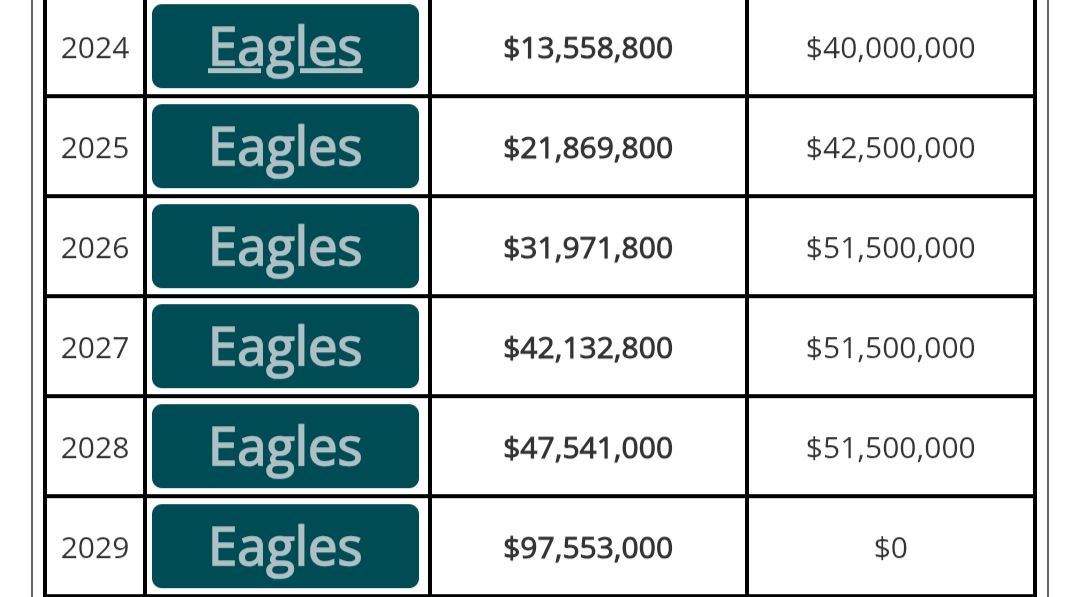
That’s Hurts’ contract, cap number on the left, cash payment on the right. By the time they hit the void year, they will have paid out $97.5 million more in cash than the cap has accounted for, almost 40% of the whole value of the contract. On top of that, the cap space that’s been saved has been spent on cash payments to other players. So while Hurts was paid $40 million last season but only had a cap hit of $13 million, the difference was spent, in cash and cap, on other players, which of course is the whole point: defer cap hits = pay more players.
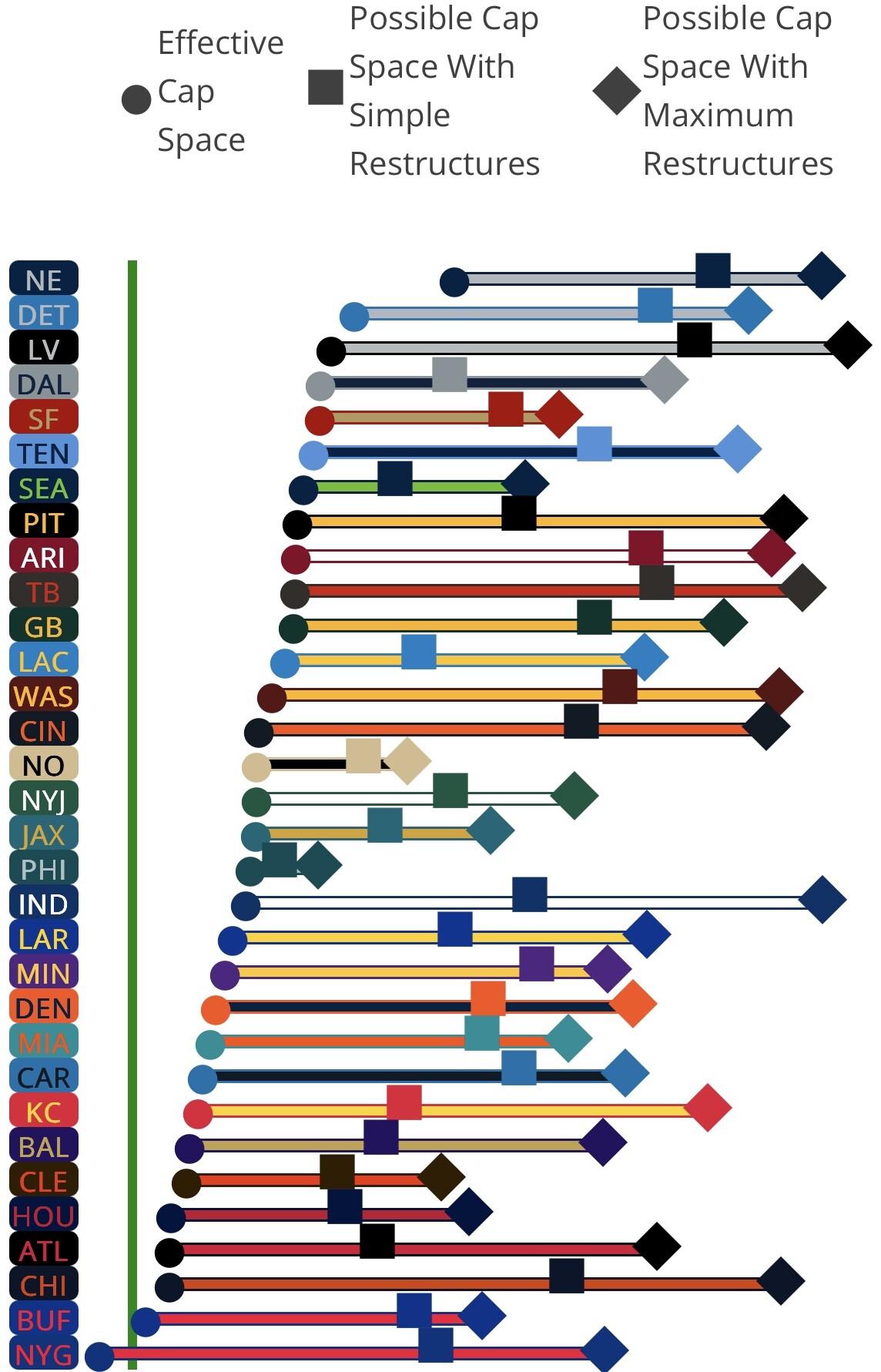
It’s standard practice to structure contracts similar to this, but the extent to which the Eagles are doing it is like no one else in the league. They have more than $400 million in void year cap charges for players currently under contract, the next highest is the Browns somewhere around $200 million. So the Eagles are committed to paying out $400 million more in cash than the cap ceiling, and a similar amount more than half the league which have either nothing or next to nothing in upcoming void year charges.
On top of that is the fact that guarantees in contracts must be held in Escrow. So while option bonuses don’t need to be paid until the date of the option, the money does need to be put aside when the contract is signed.
For any organization finding an additional $400 million in cash to spend isn’t trivial. That’s not something anyone below the owner or CEO will be able to approve. The ultra wealthy NFL owners like the Waltons can very likely just provide a borrowing facility themselves. Poorer owners like the Mike Brown or Mark Davis, whose wealth is their ownership of an NFL team, would need to borrow that money and pay interest (this is why teams have recently been allowed to sell minority ownership stakes, so as to facilitate these owners having more financial flexibility to support their teams). For any business owner, fronting that kind of money is only smart if you’re pretty certain of a profitable return, and in the NFL that certainty is difficult to establish, one injury, arrest or just a bad signing (Deshaun) can mess everything up over several years. Jeffrey Lurie is happy to support the Eagles like this, but most owners aren’t and don’t. We absolutely mustn’t make the assumption that the Lions can follow the Eagles path because it’s really not as straightforward as the media makes out, very often Howie hasn’t “done it again”, he’s just benefitting from a uniquely supportive and generous owner.
Bottom line is, if we don’t go down the void year path, it’s not Brad’s choice it’s Sheila’s. And we absolutely shouldn’t assume that we can do what the Eagles are doing.
All of the big cash payments are done year by year….
they are NOT upfront payments.
I don’t have time now… but Goff had more guaranteed at signing, same in practical guarantees, and MORE cash due up front.
The $400 million theEagles have committed to paying isn’t “additional” money being paid. It is just “borrowing” future cap space to keep current cap hits lower. That isn’t extra cash being spent now.
Yeah, Branch is going nowhere. He is the only DB on the roster who can play all the spots in the secondary in a pinch, both S spots, Nickel and even boundary corner if needed. They love versatility and Branch has that in spades.
I do think it’s possible Decker gets traded not cut. He could fetch a mid-round pick for a team needing a starting LT. That would require Manu to develop to that level or maybe a first round rookie to come in from next year’s draft.
I know that there is a belief that, “you can’t pay all of our guys.” I am not so sure. I do think with the number of contracts, the length they are likely to be, and the expanding CAP; there will be an opportunity to carefully structure Branch, Gibbs, Hutch, JAMO, Campbell, and LaPorta. I don’t think I missed someone, but I might have. IF the CAP doesn’t accelerate as much as projected, then there could be casualties, but I do believe there will be enough to move it around and I believe some simple restructuring will be in play.
Take Hurts in 2024 and let’s say there’s 10 of him. The Eagles would be paying out $400 million in cash, but only have $130 million in cap charges. Then they fill out the salary cap with $140 million in cap and cash. Eagles are spending $540 million in cash, but stay below the cap at $270 million. That’s basically how they’ve done it, and there isn’t an owner in the league who has a spare $270 million in cash to pay over and above the cap charge. The difference is that Lurie is willing to fund the difference in the short term, which allows the Eagles to load their roster.
Everything in a void year is cash that’s been paid in years prior, ie fronted up. Unless Sheila is willing to do the same, this is not an option that is open to Brad.
First nice work! I don’t follow the finances like some of you guys do and I’m sure it takes some digging let alone typing to share it.
I’ll take a bit of a different stance. Regardless of how that 26/27 cap situation looks real soon, I think the Lions and Lion fans need to perhaps focus on the current window of opportunity we’ve had and have right now to win a SB. Exercise the curse and even if the cap affects us negatively in the near future, the joy of a SB win will cover some short-term potential wounds.
You can’t chase the past but there was no excuse for the NFCGG collapse vs SF two years ago. Up by 17 at half, if Gibbs doesn’t fumble out the gate and they just burn clock, flip field position and not even necessarily kick a FG, then we already exercise the SB curse.
Sure we’re limping into the playoffs last year and defying odds, but we are manage to get first seed, have home field advantage, get a week to rest and then what do we do? We come out flat on O! (There weren’t any injuries on O like on D). We probably don’t make it to SB anyway but we are knocking and waste a home field advantage and don’t even win a playoff game.
This year we got the pieces once again and a few new ones. BH extends Hutch and Jamo to make sure there are no distractions going into this year. Just stay healthy and there’s no reason we can’t get it done. Our division was already strong and probably getting stronger. Our ex O coordinator is now in CHI and knows our weaknesses like a glove. Will the new coaches fill the void of those that left?
My point is that I’m not sure we can count on things getting any easier regardless of the salary cap going forward.
So I say all hands on deck this year. Look at this window as the culmination of 3 years of growth and humility. Punch that ticket and get it done now while the stars are aligned so that we will all sweat less the salary dilemmas coming down the road!
#1… they don’t have 10 contracts like Hurts’s deal… and they haven’t been paying significantly more cash than other teams. That is just completely inaccurate. See below.
#2… that is NOT how they have done it. They have NOT been paying large amounts of cash upfront on these contracts. I’m not sure you have understood the contract structures or how the void years actually work.
Void years don’t require ANY more cash to be paid up front… they merely delay the cash spent from hitting the cap. As I mentioned earlier, the Eagles use yearly option bonuses to help delay the cap hits into the void years, but the actual cash paid is not higher.
.
.
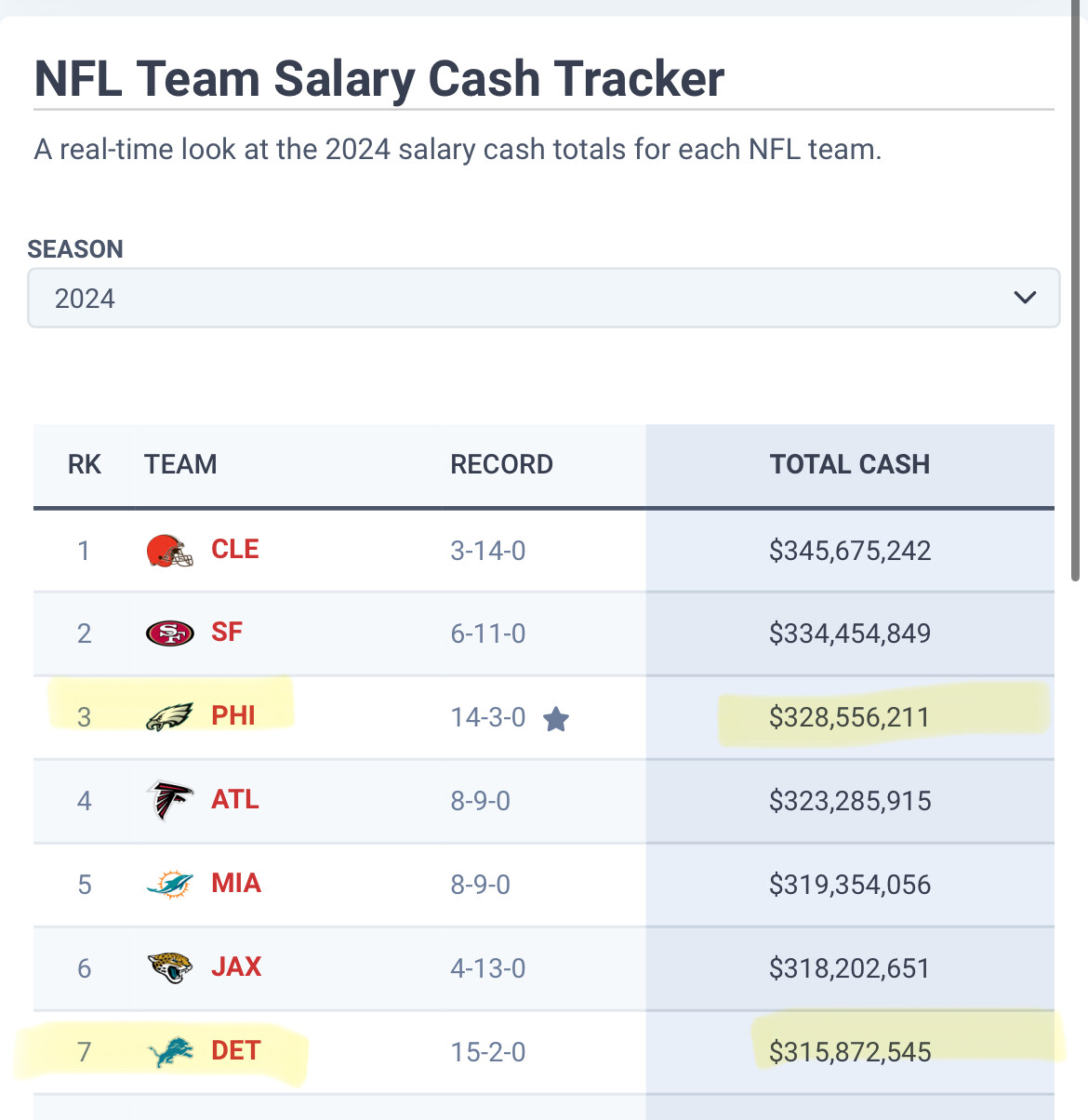
The REALITY…… is that a much younger Lions team… with many of their top players still on rookie deals… was paid almost as much cash in 2024 as the older Eagles team.
It’s a simplified example to illustrate the point. Any time the cap number is lower than the cash paid, that’s cash that’s being fronted. The Eagles don’t have 10 Jalen Hurts, but they do have Goedert, Graham, Ojulari, Blankenship, Mann, Dotson, Huff, Johnson, Baun, Mailata, Smith, Saquon, Dickerson and AJ Brown on similarly structured deals. Cash up front, cap hits later.
All of that is facilitated by ownership being willing to pay a much larger percentage of cash up front than other owners.
Just look at the contracts that I’ve listed on the Eagles. Every one of those guys has an eight figure cap hit when their contract voids. Add them all up, and that’s money that’s been paid up several years in advance of when the cap charge comes. Cash rich teams or owners can do this, cash poor teams or owners can’t.
Don’t tell me what I don’t understand because you are missing the fundamental point entirely.
One year doesn’t tell the whole story.
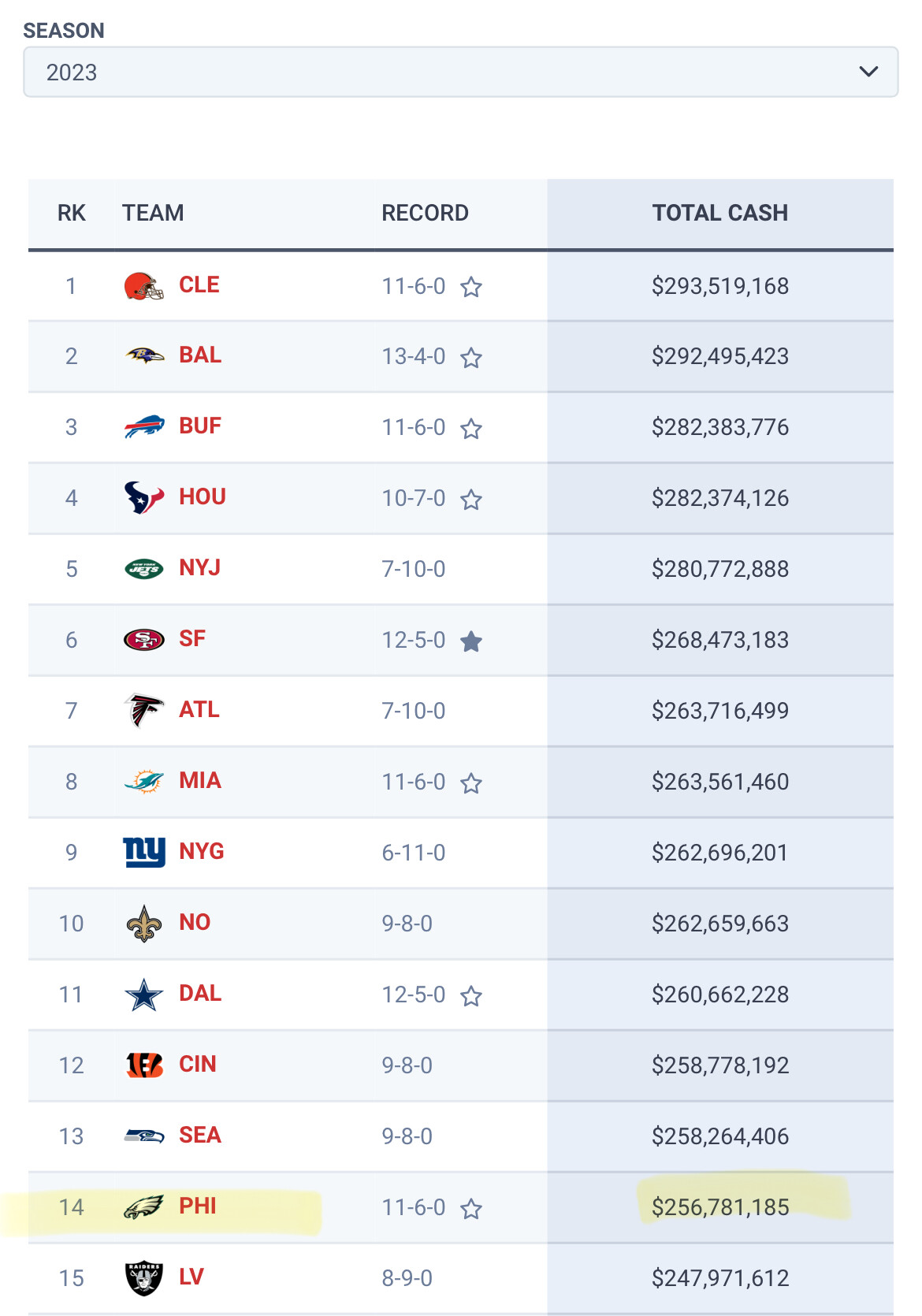
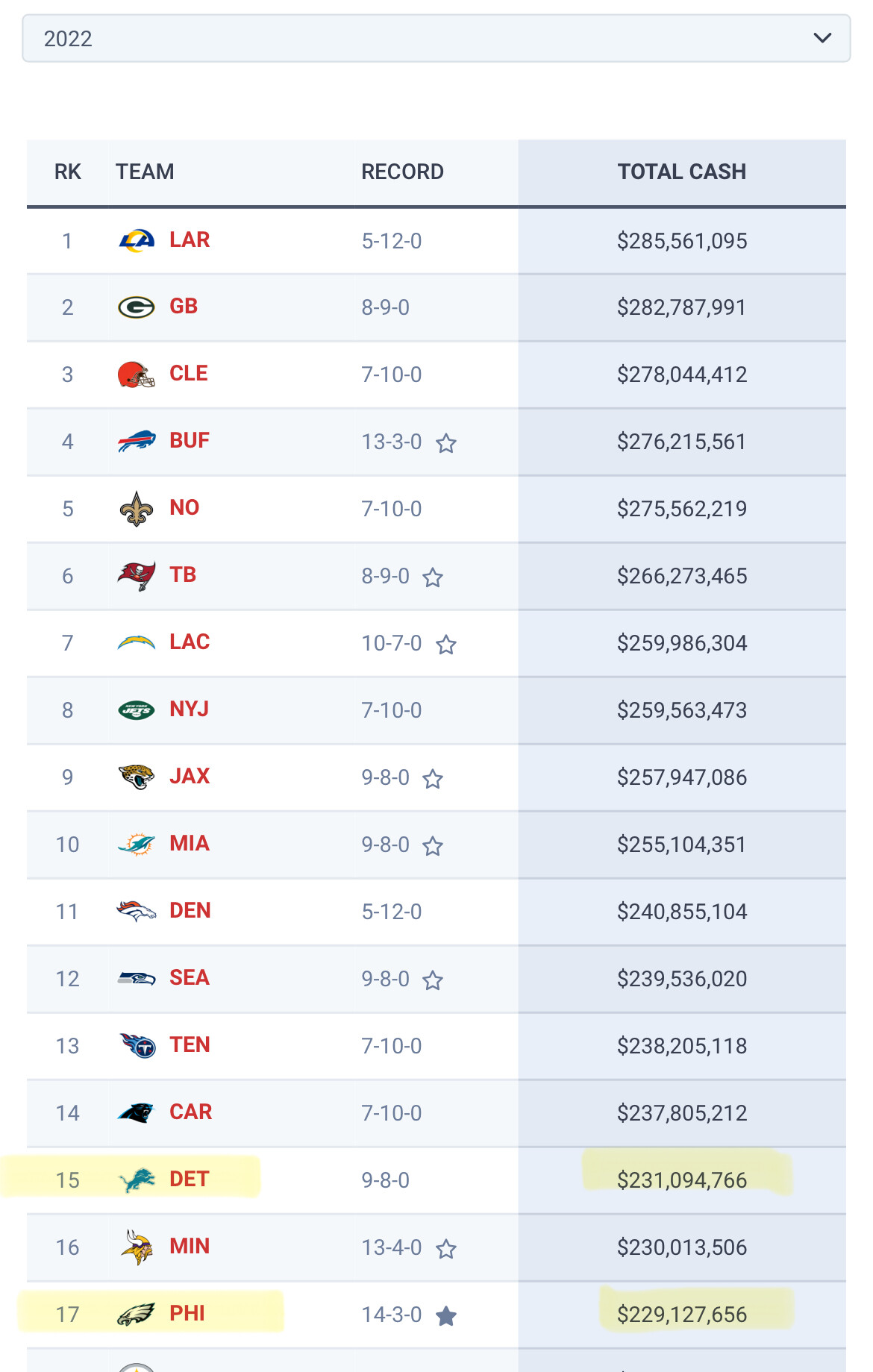
Between 2011 and 2023, the Eagles spent on average $25 million a year more in cash than the average NFL team. Over those 12 years that adds up to $300 million. Spending that much more a) gives a competitive advantage, and b) is not an option for every owner.
If it was as easy as you think, why isn’t every NFL team doing it, what’s the obstacle? The answer is the funding requirement.
I hear what you are saying. However look at the runs. Since 2020 when philly and Detroit started building basically. Cash spending i imagine is close. Yes in the PAST the Ford didn’t spend any cash. Why would they? They really never had a true reason too.
Philly has been a Legit playoff team since 2011. Lions havnt. No reason to spend big money if the team isnt good.
Philly ranked top 5 in cash apending only 2 times out of those 13 years, and they had 4 years in the top 10 for spending.
For the most years… they spent in the 12-20 range.
.
Eagles spent ~ $1.03 billion over the past 4 years.
They spent ~ $1.5 billion in the preceding 9 years.
Cleveland has spent $1.155 billion over the past 4 years…
and Detroit has spent $961,000,000 during the 4 years rebuild.
The Lions have spent only $42,000,000 less than the Eagles since Sheila hired Holmes… and 2021 was the Lions low year due to the state of the roster.
The other thing being missed by @Slay is that the $400,000,000 in “void” years has not all been paid up front. In fact, much of that is structured in yearly option bonus money.
And… when those void years actually hit, they will have tons of dead cap space (> $150 million in 2029). This dead space may result in a year of very low cash spending if they don’t continue to have a roster ready to compete for a title.
Yes… the Eagles are spending money to keep good players.
No!!! They are not front loading any of those deals in way that is different that would strain the finances of the owner.
There’s a new sport, the Slay Football League. Rosters are 1 QB and 1 DE. Salary cap is $65 million in year 1, $70 million in year 2, and $75 million in year 3. Total is $210 million. The SFL gives each team $210 million to cover the three seasons.
There are only two teams, and six players in the draft.
Mahomes ($60m per year demand)
Murray ($40m)
Rodgers ($20m)
Garrett ($40m)
Hunter ($30m)
Davenport ($20m)
Team A has the first pick in the draft.
A Mahomes
B Murray
A Garrett
B Hunter
Team B structures its contracts conventionally. Murray gets $120 million with a $60 million signing bonus, and $20 million base salary each season. His cap hits are $40 million each season. Hunter gets $90 million, with a $60 million signing bonus and then $5 million, $10 million and $15 million in base salary. His cap hits are $25m, $30m and then $35m. Team B is right up on the cap each season, and their total cash spend is $210 million.
Team A has Howie Roseman as the GM. Mahomes signs a $180 million deal, with a $120 million signing bonus, $20 million base salary and three void years on the end. His cap charges are $40 million for each of the three years of the contract, and then $60 million in year 4 when the contract voids. Garrett’s deal is similar, total value is $120 million, with a $90 million signing bonus, salaries of $5m, $10m and $15m, and three void years. His cap hits are $20m, $25m and $30m, with a dead cap hit of $45 million in year 4. Team A has $5 million in cap space each season.
In terms of cash flows, Team B pays out $145 million in year 1, $30 million in year 2 and $35 million in year 3. Total cash spend is $210 million, right on the budget.
Team A pays out $235 million in year 1, and then $30 million in year 2 and $35 million in year 3. Total cash spend is $300 million. Team A has spent $90 million more in cash than the total of the salary cap across the three years, and needs to find that money from somewhere outside what the SFL gave them when the league began.
Team A threepeats the Slay Bowl because they have a much better roster.
This is a very simple example, but it very clearly shows that the owner has fronted additional cash above the level of the salary cap in order to load the roster. Cash spending for Team A and B is identical in years 2 and 3. Team A is also $5m under the cap in each season. But Team A’s year 1 outlay was substantially bigger than Team B’s, and also more than what they were given by the SFL. Team A’s owner provided an additional $90 million up front to fund his dream team, which is more than the cap was in any single year. By having void years in Mahomes’ contract, they were able to afford and pay the necessary cash to sign Garrett. Team B, lacking a wealthy owner willing to front cash, would not have been able to sign both of those players.
Void years allow teams to spend more cash. This is an option that is only open to teams or owners who have the cash at hand to do this.