Cool stuff, next time I go to Spain…
This is the first art gallery in the world. It is 36,000 years old.
Welcome to Altamira. True Place: Altamira Cave, Cantabria, Spain.
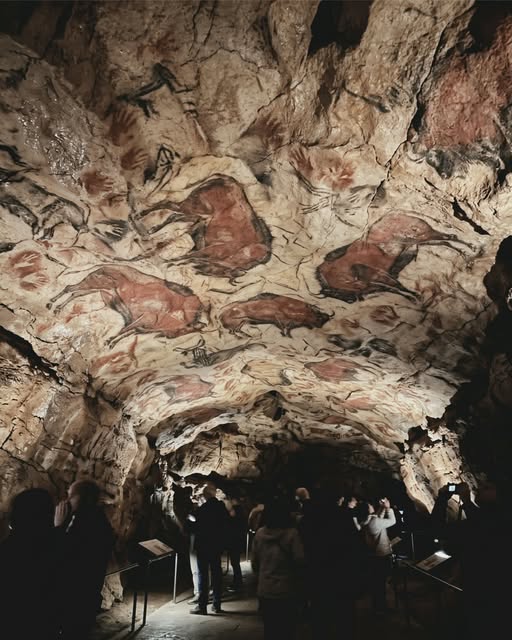
Look at this photo. Look at the ceiling. Those red animals. Those are bison. They are not painted on a wall. They are painted on a cave ceiling. And they were painted 36,000 years ago. Before farming. Before villages. Before writing. Before the Pyramids. Before Stonehenge. Before almost everything on this page.
The people who painted this were hunter-gatherers. They lived in small groups. They hunted bison, deer, and wild boar. They had stone tools. They had fire. And they had art. That is what makes Altamira so shocking. We thought art started with civilizations. Altamira proves art started before civilization.
Look closely. The bison are not flat. The artists used the natural bumps of the rock. Where the rock bulges out, they painted the belly of the bison. Where the rock dips, they painted the legs. They used the rock like a 3D canvas. They used red ochre - iron-rich earth - mixed with animal fat. They used charcoal for the black outlines. They used their fingers, brushes made of hair, and even blew paint through hollow bones to make the handprints you see at the top of this photo.
How was it found? In 1879, a Spanish nobleman named Marcelino Sanz de Sautuola was digging in this cave, looking for old tools. His 8-year-old daughter Maria was with him. She looked up at the ceiling and shouted, “Papa, mira, toros!” - “Papa, look, bulls!” Marcelino looked up. He saw the bison. He knew immediately this was ancient. But no one believed him. Scientists in 1879 said, “Stone Age people could not paint like this. This must be fake. This must be painted recently.” Marcelino died in 1888, still called a liar. 14 years later, in 1902, scientists finally admitted he was right. Altamira was real. Marcelino was right. His daughter was right.
Why did they paint it? We still do not know. Some say it was magic - paint the animal, catch the animal. Some say it was a school - teach children what to hunt. Some say it was religion - a sacred place. Some say it was just art - because humans love to create. What we do know is that they returned to this same cave, generation after generation, for thousands of years, to paint more.
In 1985, UNESCO made Altamira a World Heritage Site. Today, the original cave is closed. Only a few scientists can go inside, to protect the paintings from breath and light. The photo you see is the exact replica in the Altamira Museum - built to the millimetre, so everyone can see it. The paintings, the ceiling, the rock - everything is the same.
So tell me - if people 36,000 years ago could paint like this, were they really primitive?
Tell me in the comments - what would you paint on a cave wall for people 36,000 years from now?
True Place: Altamira Cave, Cantabria, Spain - UNESCO World Heritage, 36,000 Years Old
Wieners.
Two separate representations: an atomic explosion and an altruistic act of kindness.
Swiss researchers at University of Zurich reportedly reversed Alzheimer’s disease symptoms in 78% of elderly patients using a combination gene therapy and protein treatment. Patients regained memories, recognized family members, and resumed independent living within months.
The treatment removes toxic amyloid and tau proteins that clog brain cells. Special antibodies act like microscopic cleanup crews, while gene therapy boosts the brain’s natural protection systems. Patients receive monthly infusions for six months. Think of it like power-washing decades of debris from clogged brain pipes.
The economic controversy is staggering. American Alzheimer’s care costs families $60,000-$120,000 yearly in memory facilities. The disease bankrupts middle-class families systematically while pharmaceutical companies profit from symptom-management drugs that barely slow progression. Critics suspect industry resistance to true cures that would eliminate this profitable patient base.
For 6.7 million American Alzheimer’s patients and their exhausted caregivers, this Swiss breakthrough offers hope unavailable at home. Medicare faces $345 billion yearly in Alzheimer’s costs while a cure remains FDA-unapproved. Swiss citizens may soon access the treatment through national healthcare while Americans navigate insurance denials.
Will American families continue losing loved ones to a disease Switzerland can now reverse?
 Source: University of Zurich & The Lancet Neurology, February 2025