Lot more to find there still buried based on LIDAR and seismic. What they have now is maybe 20% of it. Some of the symbology on the megaliths are very very iiiiinteresting
2 Likes
Yes, very interesting in deed. Like. “out of this world”, interesting.
Agreed. Just seems very unlikely modern humans could’ve moved 200 ton monoliths over hundreds of miles and many cut and placed with precision we would find difficult to duplicate even today. We either aren’t being told of the history of the planet or we don’t know the history of the planet.
They are finally figuring it out.
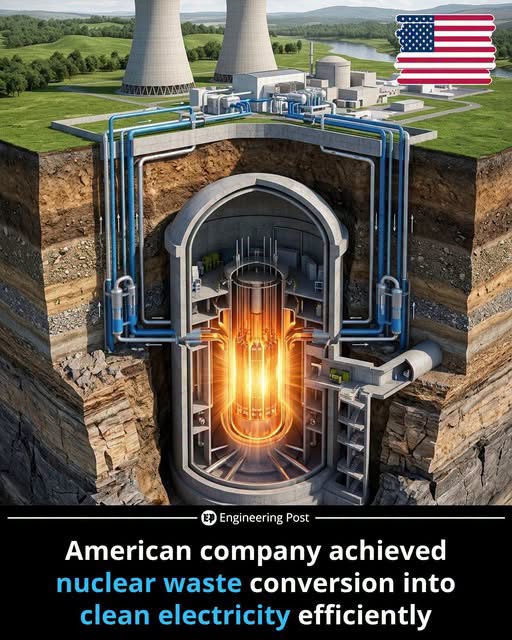
A U.S. energy startup has demonstrated a new type of nuclear reactor that uses existing nuclear waste as fuel instead of fresh uranium. The system turns a long-term disposal problem into a source of reliable, carbon-free electricity.
Unlike conventional reactors that leave most nuclear fuel unused, this technology extracts energy from the most dangerous waste components. By operating at extremely high temperatures, it breaks down long-lived radioactive materials into safer byproducts.
Experts say this approach could fundamentally change how nuclear power is viewed by the public. Reducing waste longevity from thousands of years to a few decades addresses one of the biggest environmental and political concerns around nuclear energy.
The reactors are also designed with passive safety systems, meaning they cool themselves without human intervention or water-based systems. This significantly lowers the risk of meltdown scenarios associated with older reactor designs.
If deployed at scale, existing nuclear waste stockpiles could power cities for generations without new mining. The result could be a cleaner grid, lower energy costs, and a revival of nuclear power as a climate solution.
3 Likes
Something tells me they will cost $15 billion each to construct, and we wont know for sure it works until complete. Pay up taxpayers.
Well, I don’t know what that something would be because unless you have prior evidence of tax payers paying for anything of that magnitude that is a boondoggle.
More cool stuff…
Every living thing on Earth relies on the exact same five-letter chemical alphabet (adenine, guanine, cytosine, thymine, and uracil)to build DNA and RNA. A landmark study published in Nature Astronomy by Toshiki Koga, Yasuhiro Oba, Yoshinori Takano, and their colleagues has now confirmed that all five of these essential genetic building blocks exist together inside a single pristine space rock: the ancient asteroid Ryugu.
Unlike meteorites that crash into Earth and risk getting contaminated by terrestrial microbes, Ryugu’s dark pebbles were collected directly in deep space by Japan’s Hayabusa2 spacecraft and sealed in airtight capsules. By analyzing intact rock fragments with ultra-sensitive equipment, the team unlocked the complete five-part genetic toolkit along with non-biological twin molecules, proving these compounds were forged through lifeless cosmic chemistry rather than alien biology. Even more intriguing, while other space rocks like the asteroid Bennu show heavily lopsided mixtures of these bases, Ryugu holds a nearly perfect balance of the two main chemical families – a puzzle tied to the specific blend of liquid water and ammonia that once flowed inside the asteroid billions of years ago.
This discovery reveals that our solar system was naturally manufacturing the complete chemical alphabet of life inside freezing interstellar clouds and dark asteroids before Earth even finished forming. As rocks like Ryugu bombarded the young Earth, they seeded our primordial oceans with ready-made genetic ingredients, shifting the ultimate mystery from where the building blocks of life came from to how our planet first sparked them into a living cell.
They need to ramp up ASAP…
Scientists in the United States have successfully connected multiple research facilities through a functioning quantum network — a system that transmits information using quantum entanglement instead of traditional electrical signals. Because qubits change instantly when observed, any attempt to intercept communication becomes immediately detectable. This makes the network fundamentally secure in a way no classical system can match.
Quantum communication represents one of the biggest leaps in cybersecurity. Unlike modern encryption, which can eventually be cracked by powerful computers or future AI systems, quantum data cannot be copied or secretly monitored. Banks, hospitals, national security agencies, and major corporations could one day use this network to protect sensitive information with layers of security far beyond anything available today.
While the system is still in its early stages, the long-distance quantum links achieved near Chicago prove that a larger, nationwide quantum web is possible. As the technology scales, it may redefine how the world protects data, enabling a future where hacking attempts are instantly visible — or impossible altogether.
1 Like
That sounds promising. The last thing we need right now is some gigantic financial cyber attack. Nothing freaks people out more than having their money disappear. Even if the money is restored within days, the psychological damage will be massive. We need to have faith in our financial institutions. AI definitely puts our current system at risk.