OK it’s off topic but this thread has been rather inclusive for science and things of wonder. 38,000 year art…
Some good news from the world of solar…
Japan’s new solar super panel generates more power than twenty nuclear reactors combined.
Japan has revealed the world’s first solar super panel, a jaw-dropping breakthrough built on advanced materials and radically new design. It captures and converts sunlight with stunning effectiveness, producing unprecedented amounts of electricity and marking a giant leap toward clean, abundant, nearly limitless energy for our planet. It looks like a power station folded into shining glass.
Picture entire cities and heavy industries running on this technology, with far less hunger for fossil fuels or nuclear plants. It signals a hopeful new era where the sun becomes humanity’s mightiest energy source, pouring clean power over a sustainable tomorrow for generations yet to come. No smoke, no meltdowns, no fuel shipments, just daylight doing the heavy lifting.
I wonder if it’s scalable and economically practical for the masses. I’m a big believer in renewable energy. I think our country would be much further ahead if we depended less on oil and the Middle East conflicts and tax breaks / subsidies that have cost us trillions and trillions of dollars by putting that money into renewable and clean energy. It helps the planet’s climate, makes us energy independent, and it is a cheaper more reliable alternative. A win-win-win.
that’s amazing.
and here in the US there is a prevailing thought process that wind turbines cause cancer.

And then there’s this…
America may be sitting on a trillion-dollar treasure called white hydrogen right now.
Scientists have identified a colossal underground reservoir of naturally occurring white hydrogen beneath the American Midwest. Dubbed America’s new white gold, it could rank among the biggest energy finds in U.S. history, formed by ancient chemical dances between water and iron-rich rock deep underground. Early estimates point to 250,000 tonnes hiding under Kansas alone, waiting today.
Unlike manufactured green hydrogen, this fuel needs far less processing, burns with zero carbon emissions, and could be dramatically cheaper. If extracted safely and economically, it might power industries, transport, and grids for decades, a prize potentially worth trillions that has geologists and energy giants electrified underground. The clean energy race may have a surprise new leader.
I know at one point a few months ago I was talking through a more General sense of resources. There is an absolute s*** pile more of oil gas minerals water you name it that we haven’t even begun to scratch the surface of (literally too). I don’t know and we won’t even have a clue as to how much it is for decades. I’m sure this is part of my rant against peak oil dipshittery and it just keeps coming truer and truer across the board as far as most any resource…
Been waiting on this one for a while…
A nuclear reactor with a footprint smaller than many living rooms is moving closer to operation in Texas.
Last Energy’s PWR-5 pilot microreactor, planned for Texas A&M University’s RELLIS campus, is designed to produce 5 megawatts of power. The company says its nuclear island—the core reactor area occupies just 114 square feet.
In October 2026, the U.S. Department of Energy approved the project’s Documented Safety Analysis, a major milestone in the federal authorization process. The project has now advanced to a readiness review, the final step before the department can authorize startup and initial nuclear criticality.
But approval of the safety analysis is not permission to begin operating. The reactor still needs the required startup authorization before it can demonstrate its capabilities.
Why does this matter?
Microreactors are designed to deliver dependable power from relatively compact nuclear systems. If they can be built and operated economically, they could serve industrial facilities, remote locations, research sites, and other users that need reliable electricity.
Small reactors could also become part of the conversation around rising electricity demand from advanced manufacturing and data centers. However, their long-term potential depends on more than size: construction costs, fuel supply, safety, waste management, regulatory requirements, and performance in real-world operation all matter.
The Texas project is a demonstration, not yet proof that the technology can be deployed commercially at scale.
Nuclear innovation is moving forward, but the real test will be whether these compact systems can deliver reliable electricity safely, affordably, and consistently.
Could microreactors become a practical part of the future energy mix, or will cost and deployment challenges limit their role?
Pretty cool. I wonder about the expected lifespan and safety guard rails.
This looks like the test phase, but I have a spare bedroom that I could fit that thing in.
Went to see Prof Brian Cox last night. Mind blowing stuff!
Where was he at? I saw Neil deGrasse Tyson last year in Columbus, Ohio. Very entertaining and obviously a sharp guy.
Nice.
Would also like to see Neil diamond do grease with Tyson. VERY entertaining
Glasgow in Scotland. A big show in a decent sized arena
Started with the military in 1960’s
OK, more cool stuff.
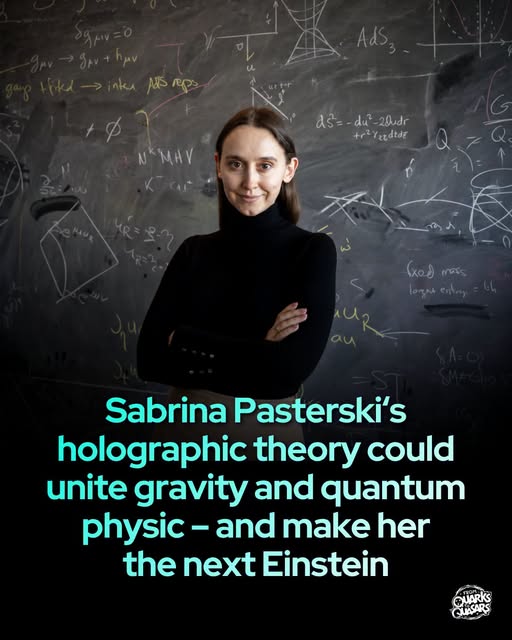
Sabrina Pasterski has been described as the next Einstein.
The physicist is helping develop a theory that could connect gravity and quantum physics by describing the same events in fewer dimensions.
The idea is called celestial holography.
In everyday life, we move through three dimensions of space and one of time. But researchers are investigating whether gravitational interactions in this four-dimensional spacetime could have an equivalent description in a two-dimensional quantum theory.
That could offer a new way into one of physics’ hardest problems.
Einstein’s general relativity explains gravity through the curvature of spacetime. Quantum physics describes particles and their interactions. Both work remarkably well, but a complete theory combining them remains elusive.
Pasterski’s research starts with something concrete: particles coming together, interacting, and flying apart.
Physicists calculate the probabilities of those outcomes using mathematical quantities called scattering amplitudes.
Celestial holography reorganizes those calculations around the directions particles arrive from and travel toward, mapped onto an imaginary sphere.
Something surprising happens when the calculations are rewritten this way.
They take a form associated with a two-dimensional quantum theory known as a conformal field theory.
Researchers are trying to establish whether these are two complete descriptions of the same physics. If they are, a difficult problem involving gravity could potentially be solved using the corresponding quantum description.
The sphere is a mathematical construction. The proposal does not establish that the universe is a projection or simulation.
The approach remains unfinished.
One of these is true; she’s never taken a bong hit, or she’s taken too many bong hits. 
Now that I swallowed Quantum Entanglement, I don’t need any cherry flavoring for this. My mind is so thoroughly blown, who am I to quibble with Sabrina?
Thanks as always.
Change of pace, the past instead of the future…https://www.smithsonianmag.com/history/gobekli-tepe-the-worlds-first-temple-83613665/?utm_medium=social&utm_source=facebook&utm_campaign=editorial&utm_term=1122025&utm_content=archival-card&fbclid=IwY2xjawVV-IdleHRuA2FlbQIxMABwZG9mAWJyaWQRMUFTS0JGWWtzU3J1dHBLUGRzcnRjBmFwcF9pZBAyMjIwMzkxNzg4MjAwODkyAAEfjNl6MKWv-muu6ljIpLy0iN-jNw7GqAbW9He8iUmi3j72vM5TdXfMpHZf5ro_aem_sfAoI-lHjwK-mqUJDWwfUA