James Webb telescope

Just saw another video that blew my mind

This is what hubble just did.

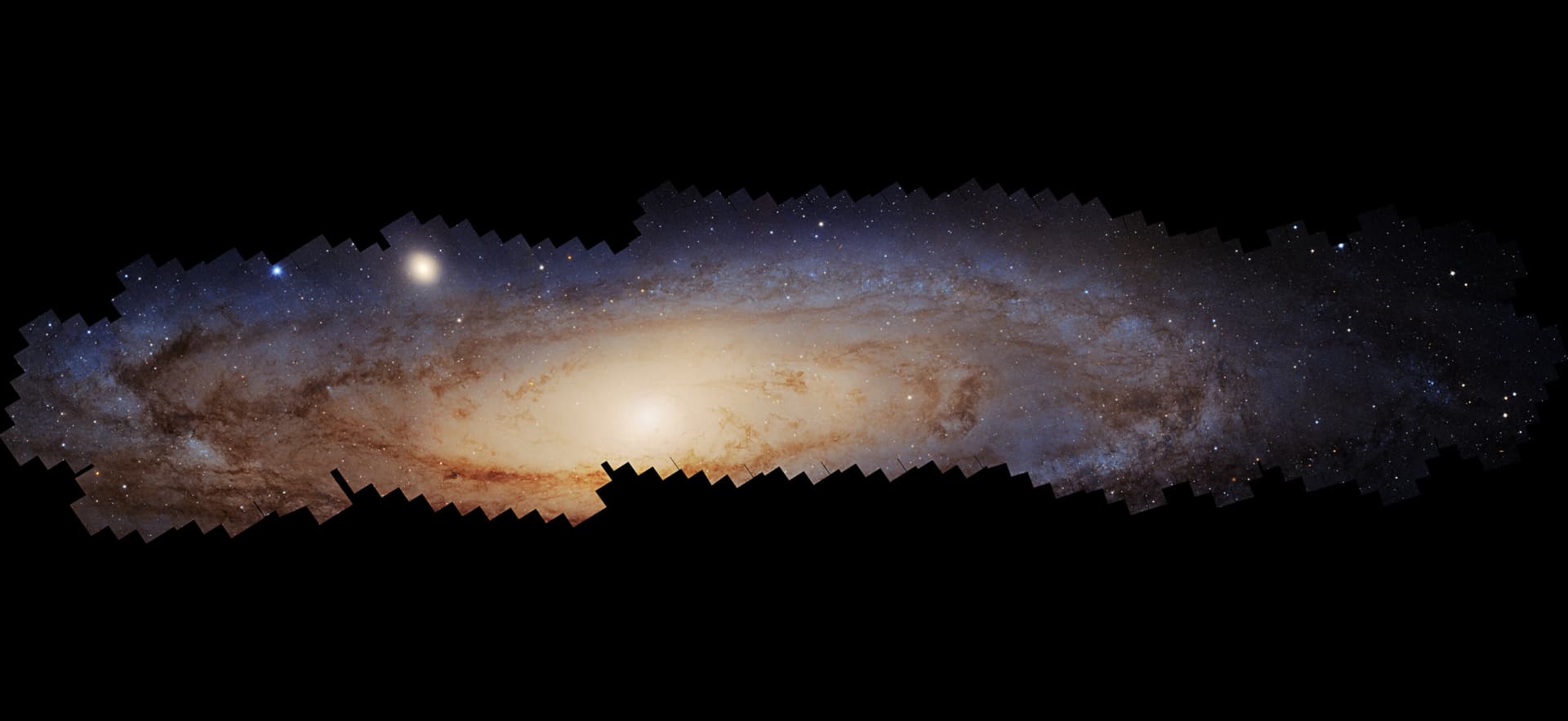
The Andromeda galaxy. It took 600+ photos. And over 10 years. (Because you have to wait to be lined up to take the photo) from 2015 to 2025

NGR will take an afternoon to do the same thing.

2 Likes


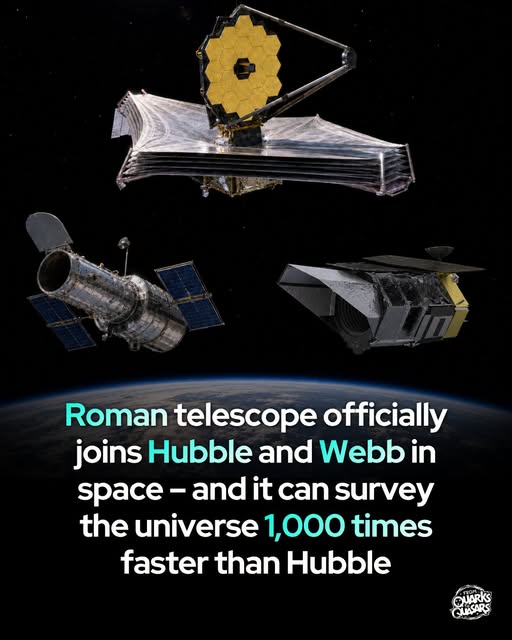
Roman, Hubble, and Webb are now in space – each seeing the universe in a different way.

Hubble sees sharply. Webb sees deeply. Roman sees widely.

NASA’s Nancy Grace Roman Space Telescope launched from Florida on August 30 aboard a SpaceX Falcon Heavy rocket.

The $4 billion observatory is now traveling approximately 1 million miles (1.6 million kilometers) to the second Sun-Earth Lagrange point, known as L2. It will spend about three months reaching its destination and completing tests before NASA releases its first images, expected by early 2027.

Roman’s specialty is seeing the bigger picture.

Its 7.9-foot (2.4-meter) mirror is the same size as Hubble’s, but its field of view is at least 100 times wider. A single Roman image can capture roughly the same area as 100 Hubble images while maintaining similar sharpness.

That will allow Roman to survey the universe up to 1,000 times faster than Hubble. It will study more than a billion galaxies, investigate dark matter and dark energy, and search for more than 1,000 planets beyond our solar system.

Hubble, meanwhile, remains astronomy’s precision observer.

Orbiting roughly 320 miles (515 kilometers) above Earth, it studies the universe in ultraviolet, visible, and near-infrared light. Since 1990, Hubble has captured detailed views of planets, stars, nebulae, and distant galaxies, helping scientists measure the age and expansion of the universe.

Webb looks deeper.

Located near L2, the James Webb Space Telescope uses a 21-foot (6.5-meter) mirror and powerful infrared instruments to examine some of the earliest galaxies, peer through clouds of cosmic dust, and study the atmospheres of distant planets.

Roman will find enormous numbers of objects across wide areas of the sky. Webb can then examine selected targets in extraordinary detail, while Hubble adds observations at wavelengths the other two cannot fully see.
3 Likes

that’s insane and wonderful.

Don’t get too excited – but the world’s largest detector spotted a single weird particle.

The LUX-ZEPLIN experiment, the world’s largest detector built to search for dark matter, observed a single high-energy interaction inside its tank of ultrapure liquid xenon.

Researchers investigated whether it could have been produced by a stray neutron, gamma ray, detector malfunction or another known source. So far, none of those explanations fits convincingly.

That raises an extraordinary possibility: the detector may have recorded a particle of dark matter.

Dark matter cannot be seen because it does not emit, reflect or absorb light. Scientists infer its existence from its gravitational influence on galaxies and estimate that it constitutes roughly 85% of all matter in the universe.

LUX-ZEPLIN attempts to detect it directly by watching for an invisible particle striking the nucleus of a xenon atom and causing it to recoil.

The unexplained event deposited approximately 248 kiloelectron volts of energy—far more than expected from the conventional dark-matter particles the experiment was designed primarily to find.

If dark matter caused it, the particle may interact with ordinary matter in a more complicated way than standard theories predict. It could possess an internal structure or interact more strongly during higher-energy collisions.

But one event is nowhere near enough to declare a discovery.

Researchers estimate there is approximately a one-in-200 chance that the signal is a statistical fluctuation. Particle physicists generally require odds of roughly one in 3.5 million before announcing a discovery.

The team has already collected about three times more data than was included in this analysis. Other detectors in Italy and China can also search independently for similar high-energy events.

If more signals appear, this event could become the first glimpse of the invisible matter holding galaxies together.

2 Likes

I won’t get too excited, though I am interested because I took the under on dark matter in predictive markets. You’d expect that from a founding member of the Dark Matter Untruthers.

2 Likes

Every time I see that guy I think of Chet…not a good ambassador of the space abyss IMHO :poop:

christmas selfies GIF

1 Like

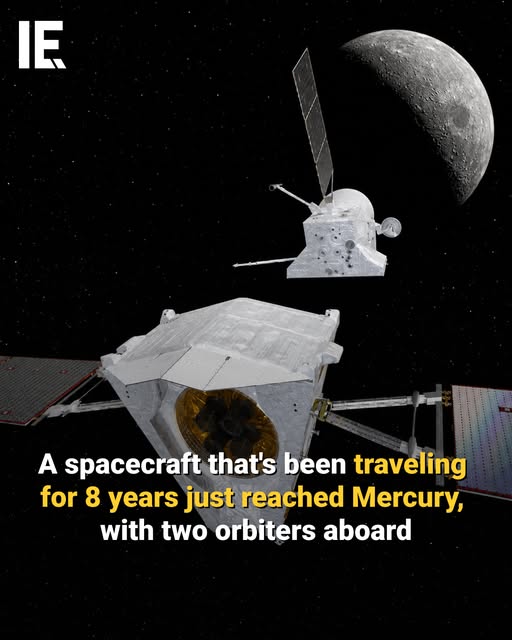
BepiColombo, the joint ESA and JAXA mission to Mercury, reached a critical milestone on September 3 when it separated its Mercury Transfer Module — the propulsion unit that powered the spacecraft through 8 years of interplanetary travel, including nine planetary flybys and six close passes of Mercury itself. What remains is a historic first: two orbiters — ESA’s Mercury Planetary Orbiter (MPO) and JAXA’s Mio — traveling to the same planet together. “For the first time, we’ll have a single mission with two orbiters going around the same planet,” said Professor Geraint Jones, BepiColombo’s Lead Project Scientist. MPO will map Mercury’s surface, interior, and tenuous atmosphere using X-ray imaging, while Mio will study the planet’s magnetic environment and solar wind interactions. The orbiters will enter Mercury’s orbit on November 21, with science operations beginning on April 6, 2027. Getting to Mercury is notoriously difficult: anything launched from Earth carries our planet’s orbital velocity, making it necessary to lose enormous amounts of energy to fall inward toward the Sun. BepiColombo solved this through a series of gravity assists spanning Earth, Venus, and Mercury over nearly a decade. The mission took 15 years to build its instruments alone.

2 Likes

Thanks, I really appreciate you posting these mind-blowing tidbits. Science is still a thing!!!

2 Likes

Thanks just glad other people appreciate it because every day it seems there’s something going on that is really fantastic.

2 Likes

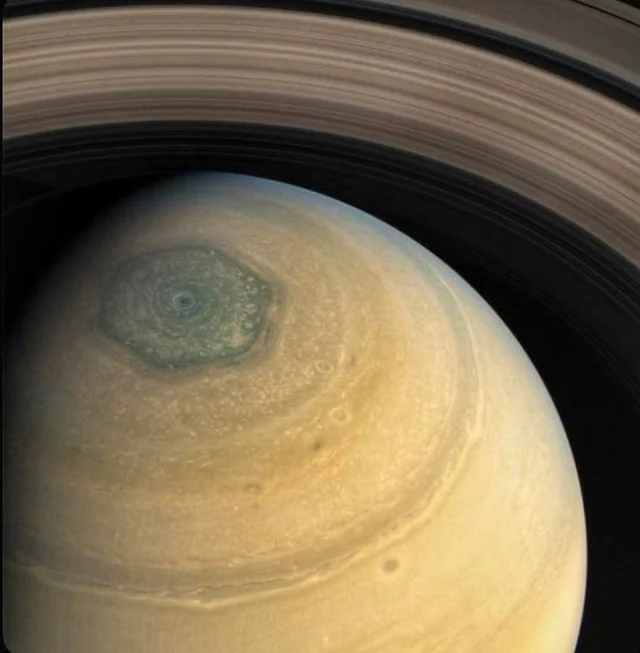
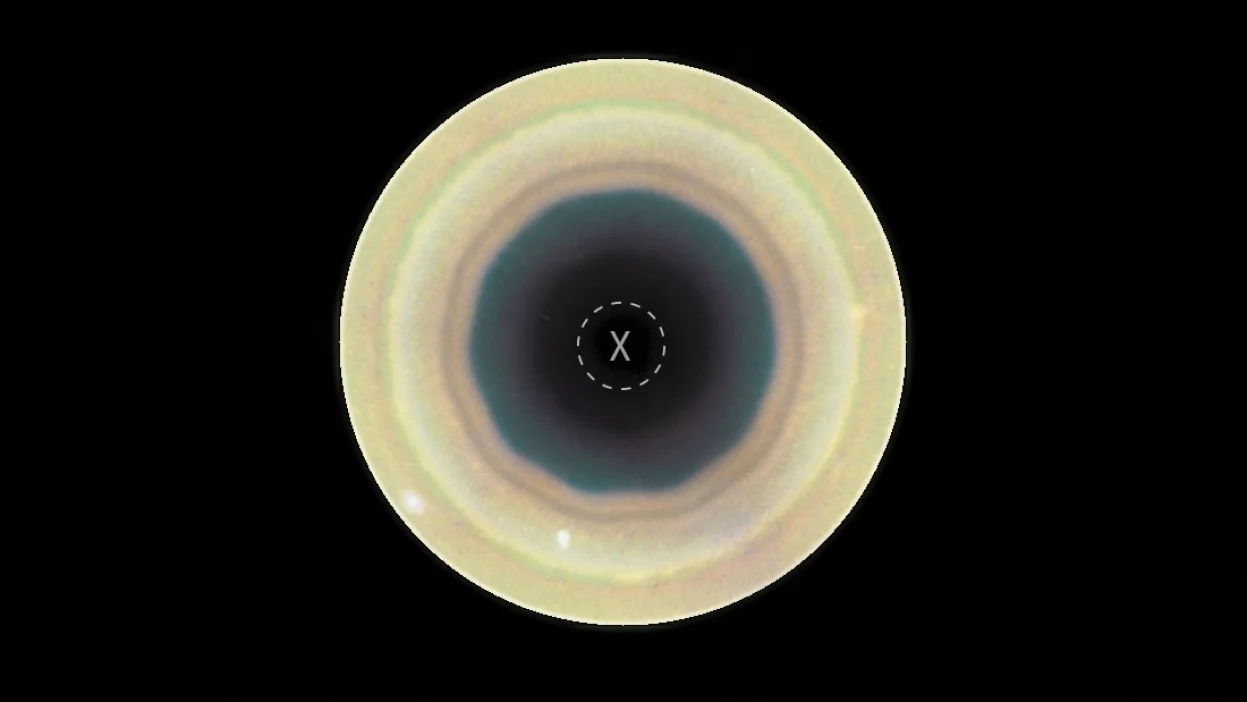
Saturns poles have geometric shapes

The north pole has a hexagon

The south pole was just confirmed to be a decagon

Like how?!?!? Why???

2 Likes