Those look like my super sperms.
2 Likes
Cuz it doesnt really look like that.
You ■■■■■■ welcome back!
2 Likes
AI accelerates lying to lightspeed.
Good work humans!
1 Like
10 years ago today was the first direct detection of gravitational waves. When I read different journals I am always amazed how people like Einstein and Hawkins theorized so many things that are proven to be correct.
3 Likes
And the hits keep on coming…
2 Likes
Pretty cool…this links to Weasel’s post.
1 Like
Move faster in space and time slows down. Stand still and time moves at its fastest.
This idea comes from Einstein’s theory of relativity, which revealed that space and time are not separate things but part of a single fabric: spacetime. Your motion through one affects how you move through the other.
Think of it like a balance. Every object in the universe is always moving through spacetime at a fixed overall rate. If you’re not moving much through space, then nearly all of that motion is through time – you age as quickly as nature allows. But if you’re moving quickly through space, some of that motion is “spent” on distance, leaving less available for time. Your personal clock ticks more slowly compared with someone at rest.
We’ve tested this with atomic clocks flown on airplanes and satellites. Astronauts aboard the International Space Station experience it too. Their time runs a little slower than ours on the ground. And GPS satellites depend on constant relativistic corrections to stay accurate; without them, navigation would fail within hours.
Take the idea further, and the consequences are striking. At everyday speeds, the effect is tiny. But as you approach the speed of light, time nearly grinds to a halt for you while it continues for others. A journey of just a few years onboard a near-light-speed ship could mean centuries pass back on Earth.
Relativity shows that there is no single, universal flow of time. Each of us carries our own clock, shaped by our path through spacetime. When you stand still, you move fastest through time. When you move fast, you slow your passage through it.
Even at rest, you are racing into the future. Take a moment to reflect on that today.
In a quiet lab in Vienna, a group of physicists ran an experiment in 2012 that should have been impossible. They fired two entangled photons — particles of light linked across space — into a carefully built quantum setup. One photon was measured immediately. The other was delayed using a long optical fiber. But when they compared the results, something strange happened: the outcome of the first photon’s measurement appeared to be influenced by the second, which hadn’t been measured yet. Somehow, the future was affecting the past.
This baffling phenomenon was later confirmed in several experiments around the world. It’s now known as the Delayed Choice Quantum Eraser — a mind-bending concept where the act of observing a particle can seemingly reach back in time to change what happened before the observation. To be clear: no one is sending messages into the past. But what we are seeing suggests time, at the quantum level, doesn’t behave like the linear arrow we experience in daily life.
In classical physics, cause always precedes effect. But in quantum mechanics, particles don’t seem to care. If a photon is given the “choice” to behave like a particle or a wave, its behavior isn’t fixed until it’s measured — and incredibly, the way we choose to measure it can retroactively determine how it acted before the measurement. This isn’t just theory anymore. It’s been observed in peer-reviewed lab setups using ultra-sensitive detectors and state-of-the-art photon sources.
One version of the experiment split a photon into two entangled twins. One traveled to a detector where it was measured directly. The other passed through a system where scientists could either preserve or erase which-path information — after the first photon had already been detected. The eerie result: the earlier measurement lined up with the later choice, as if the particle somehow “knew” what its partner would encounter.
This shakes the foundation of causality. While no information can travel faster than light — meaning no violation of relativity — the implication is deeper: at the quantum level, reality isn’t determined until it’s observed, and sometimes, observation in the present seems to sculpt the past.
Some physicists think this hints at a universe that’s fundamentally interconnected across space and time. Others wonder whether time itself might be an emergent illusion — something that appears orderly only when observed at scale. Either way, the more we look into quantum mechanics, the more reality stops behaving like reality.
And if the past can be changed by the present… what else might be possible?
1 Like
James Webb Observations to date…

1 Like
Germany has just achieved a historic breakthrough in nuclear fusion at the Wendelstein 7-X stellarator, where plasma burned like a miniature sun for an astonishing 30 minutes straight. By twisting plasma inside magnetic fields designed to mimic the Sun, scientists created one of the most stable and sustained fusion reactions in history—bringing humanity closer to limitless clean energy.
This experiment proves that fusion can be held far longer than the few seconds achieved in other reactors, making it a massive step toward real-world power plants. With zero carbon emissions, no long-term radioactive waste, and fuel derived from hydrogen, fusion could one day provide nearly endless energy for the planet. The future of power isn’t just coming—it’s already glowing like a star in Germany.
I hope to be around when all these energy alternatives are actually up and running.
In other pretty cool science news…
This massive detector was created to uncover the secrets of one of the most mysterious particles in the universe.
Known as JUNO, the underground lab was built to help scientists study the neutrino.
These tiny particles are everywhere, around 400 trillion from the Sun pass through your body every second, but they almost never interact with matter, which makes them incredibly hard to detect. To spot even a few of them, researchers placed JUNO 700 meters underground, between two nuclear power plants that also produce neutrinos. The goal is to record around 40 to 60 neutrino events per day for the next 10 years.
At the heart of the detector is a giant sphere filled with special liquid that lights up when hit by a neutrino. Surrounding this sphere are over 43,000 super-sensitive sensors that can pick up even the tiniest flashes of light. On top of all this is another detector, called the Top Tracker, which helps filter out unwanted signals from other particles that might sneak in. JUNO’s main mission is to better understand the three known types of neutrinos, electron, muon, and tau, and figure out how they transform, or “oscillate,” into one another.
One big mystery is how much each type weighs, or at least which one is the heaviest and which is the lightest. Cracking these questions could reveal how the early universe expanded, how supernova explosions work, and even help us understand what’s happening deep inside Earth. JUNO is a global effort, involving 74 institutions and 700 scientists, and it’s designed to run for at least a decade.
5 Likes
The vastness of space really blows my mind.
Just our solar system.
A 1:14,910,000 scale model.
Put the sun at the Cape Canaveral Light house.
The radius of the sun would be about the hight of the lighthouse. ~151ft
Mercury would still be only 2miles away. Still in the Nasa base
And only 1ft wide.
Venus just outside the base at 4.5 miles
And 2.7ft wide
Earth? About 6 miles away at the SSPF space center. And 2.8ft wide
The moon would be only 80 feet away and 9” wide
Mars still just barely on the merrit Island. 8 miles away 1.5 feet wide
The astroid belt would be the western Indian river.
(Yes the inner solar system would fit on Cape Canaveral)
Jupiter would be halfway to Orlando.
30 miles from the lighthouse .
And about 31ft in diameter.
Saturn would be at Disney World.
About 60 miles away and 26ft wide
Uranus would be in Jacksonville
11ft wide
Neptune north of Gainsville
10.5ft wide
Pluto and the kipper belt would be in Tallahassee.
Pluto only 6” wide
So the “solar system” fits in Florida, but heres what really puts it in perspective.
Termination shock (where solar particles from the sun start to slow) would be all the way in New Orleans
Heliopause (where the solar particles from the sun completely stop) would be in houston tx
Voyager 1. Would be over 1000miles away at the SpaceX star base in south texas. (Traveling at 0.05 inches per second)
But the edge of the solar system? The Ort Cloud. Where the gravitational effects of the sun are no longer felt?
THE MOON! Over 250,000 miles away!
The next closest star (proxima centuri) would be as close as Uranus
The center of the Milky Way would be Voyager1
So if everything was nearly 15 million to 1 scale.
From florida to the moon would be the solar system.
Yet everything in it would fit in a 250ft cube,
Its sooooo empty.
3 Likes
“There is a place with four suns in the sky — red, white, blue, and yellow; two of them are so close together that they touch, and star-stuff flows between them. I know of a world with a million moons. I know of a sun the size of the Earth — and made of diamond. There are atomic nuclei a few miles across which rotate thirty times a second. There are tiny grains between the stars, with the size and atomic composition of bacteria. There are stars leaving the Milky Way, and immense gas clouds falling into it. There are turbulent plasmas writhing with X- and gamma-rays and mighty stellar explosions. There are, perhaps, places which are outside our universe. The universe is vast and awesome, and for the first time we are becoming a part of it.”
Carl Sagan (Planetary Exploration 1970)


2 Likes
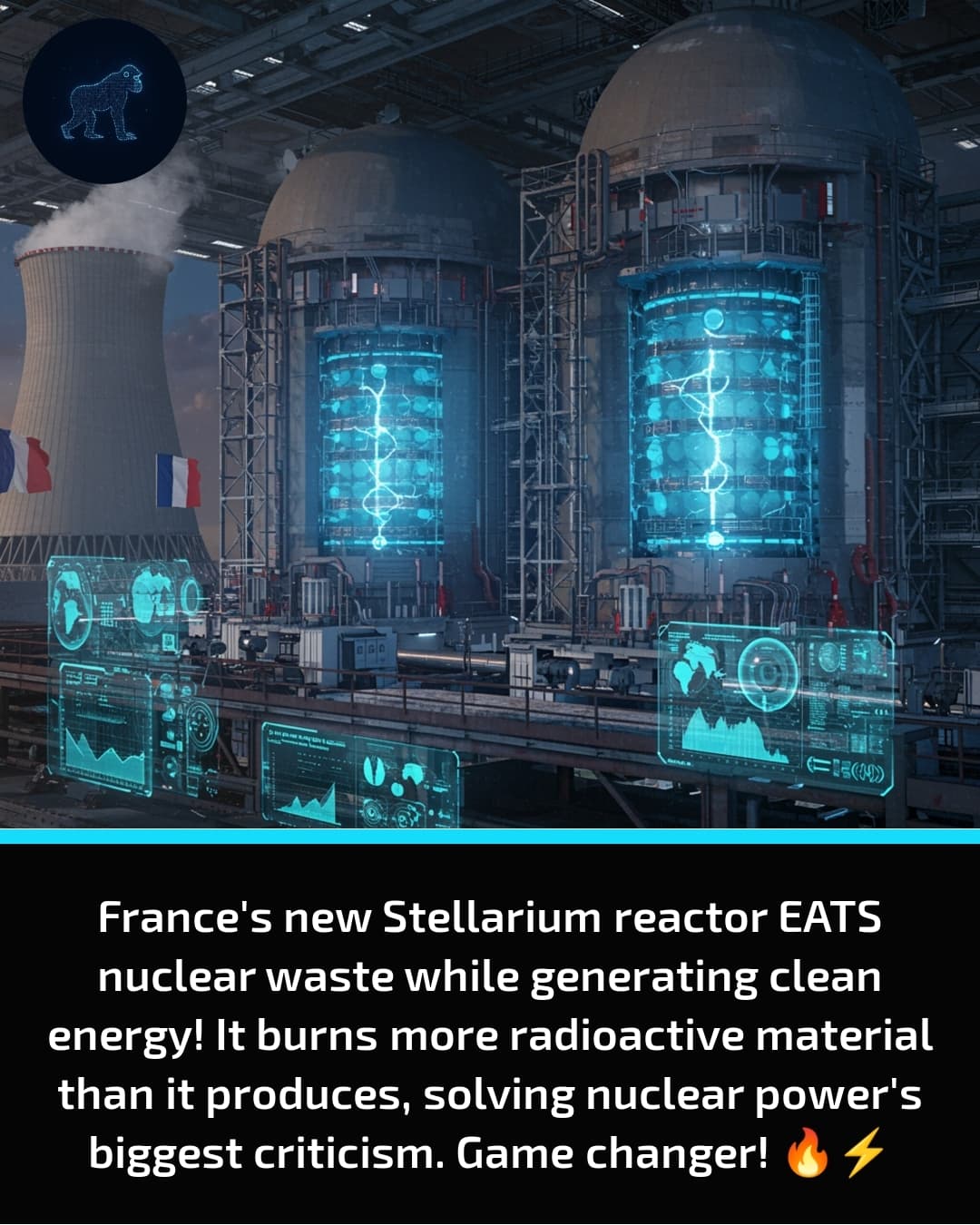
that’s interesting
" The Stellarium reactor is a revolutionary fast breeder molten salt reactor developed by French startup Stellaria, designed to destroy more long-lived nuclear waste than it produces while generating clean energy for cities and industries. Key innovations include a closed fuel cycle for 100% fuel reuse, passive safety features relying on natural convection, operation at atmospheric pressure, and a compact design. Stellaria plans to have its first prototype operating by 2029 and commercial deployment by 2035."
3 Likes
The universe has no center it’s expanding everywhere, all at once. Modern cosmology, guided by Einstein’s theory of general relativity and supported by decades of observation, shows that galaxies aren’t flying away from a single explosion point. Instead, space itself is stretching, carrying everything within it along for the ride.
Imagine the universe like the surface of an inflating balloon. Every point moves away from every other point, yet there’s no true “center” on the surface itself. In the same way, the universe isn’t expanding into anything it is the expansion. No matter where you are in the cosmos, you’d see galaxies moving away in every direction, just as any observer would.
In this four-dimensional spacetime, concepts like a “center” or “edge” simply don’t apply. The real wonder is that the universe is growing everywhere at once a cosmic reminder that in an infinite, expanding reality, every point can be seen as the middle of everything.
Sources/Credits: The Conversation (2023), NASA, ESA, and Einstein’s Theory of General Relativity.
2 Likes

Carl definitely got ahold of a good bag in 1970.
1 Like

StarShip Flight 11 happened Sunday night.
Its the last test that was launched from the Original Pad. And the last test of booster V2.
All future tests will have booster v3. And launched from pad 2.
And the test was textbook perfect
The biggest thing tested was, the ship coming back down. They had it glide down much more slowly, so it didnt break the sound barrier. Which people of Texas and Mexico were very upset with,
Understandably so. Because those booms were LOUD
1 Like