Well, it appears that in the USA, at least, super-rich and powerful corporations have been welcomed through the front door on their way to stealing everyone’s data and paving the way for some social credit scheme, where you’d better shut up and play their game… or else.
1 Like
Ah well, I’ll see how long I can hold out down in the jungle. Wish the climate was cool enough to grow lots of veggies, but oh well.
Oh, that’s already here. They don’t need quantum computers for that. They already own all of us.
More like idiocracy but I get what you’re saying 
So in layman’s speak, QC has the potential to break crypto/blockchain encryption and render it anywhere from less useful to useless.
Yes?
QC would make it trivially easy to crack ALL prior encryption methods that are not designed to withstand it.
1 Like

Well, we need whatever encryption that makes Hellfire missiles bounce off of UFOs…
I found it’s home base…
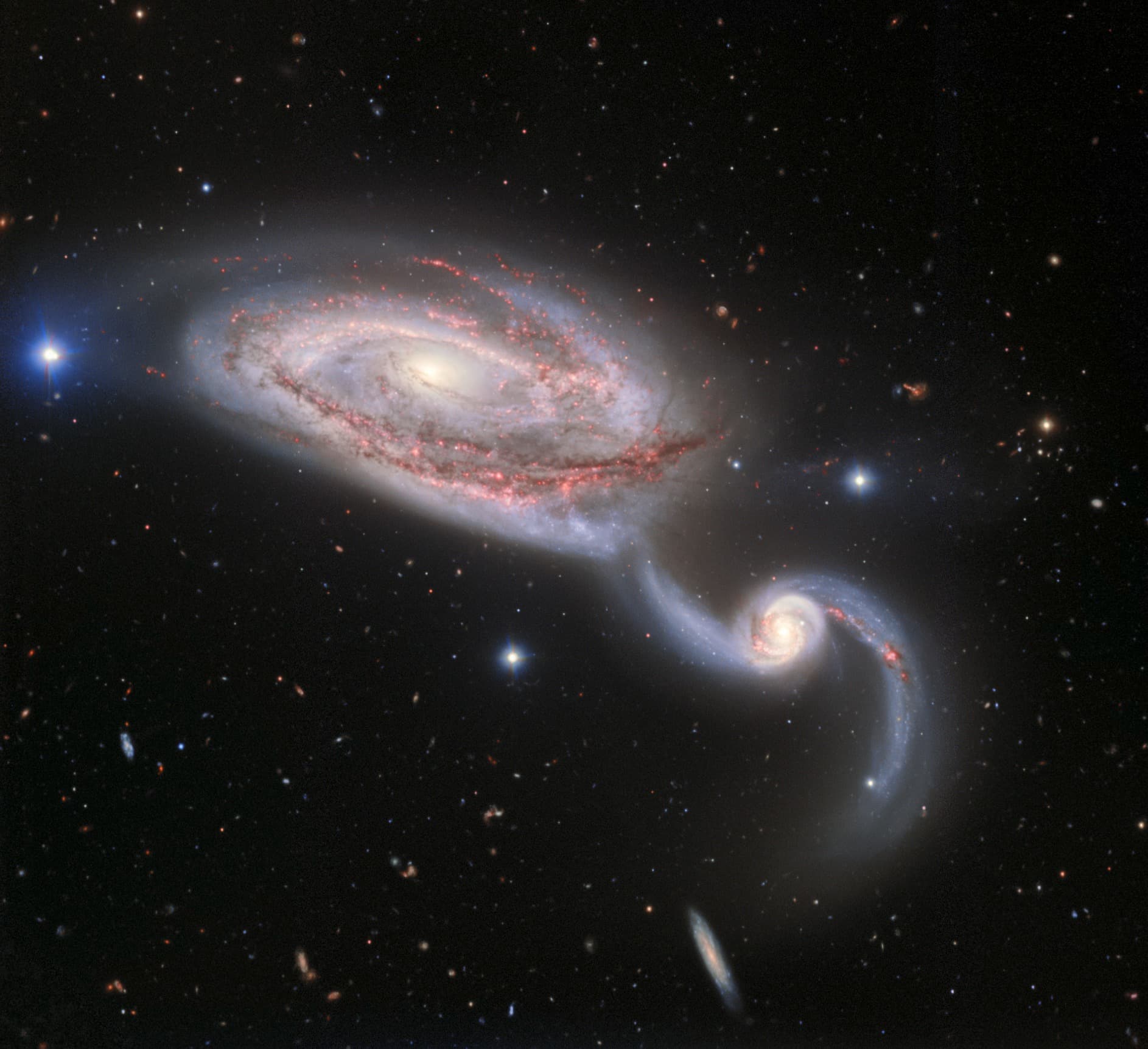
NGC 5395
Constellation: Canes Venatici
Distance: 160 million light years
RA: 13h 58m 38.0s
Dec: +37° 25′ 28″
NGC 5395 is the larger of two interacting spiral galaxies, located about 160 million light-years away. It is a large spiral galaxy with a diameter of approximately 140,000 light-years, which is distorted by its gravitational interaction with the smaller, barred spiral galaxy NGC 5394.
Credit: International Gemini Observatory/NOIRLab/NSF/AURA

3 Likes
This was cool…
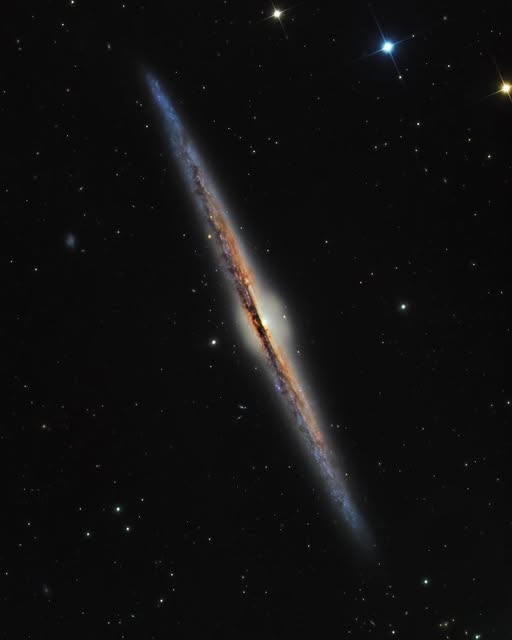
The Needle Galaxy (NGC 4565) stretches across the cosmos like a thin blade of light, seen perfectly edge-on from Earth. Located about 40 million light-years away in the constellation Coma Berenices, it reveals the stunning structure of a spiral galaxy from the side.
 Why it captivates:
Its razor-thin profile makes it one of the most iconic edge-on galaxies.
A glowing central bulge framed by delicate dust lanes.
Proof of the immense scale and elegance of galactic architecture.

further evidence the earth is flat
2 Likes
Sun is flat too, just perpendicular to us. Same as the moon. And everything else in the solar system. Except Earth. Because the dinosaurs tipped it over, those fat ■■■■■.

Them and the Canadians
1 Like


Curious as to how those galaxies don’t tear each other apart?
They are not in love?
3 Likes
I’m curious as to why I can’t copy and paste any photo’s w/o 2 of them posting.
Oh and this is curious too…
Graphene’s electrons just did something physicists thought was impossible.
For nearly 200 years, metals have obeyed the Wiedemann-Franz law – the rule that electrical conductivity and thermal conductivity always rise and fall together. But in ultra-clean graphene, researchers at the Indian Institute of Science found the opposite. As electrical conductivity increased, thermal conductivity dropped, shattering a principle taught in every physics textbook.
The key lies at the “Dirac point,” a strange electronic tipping point where graphene is neither a metal nor an insulator. Here, electrons stop behaving like individual particles. Instead, they flow collectively as a nearly perfect fluid – a state called a “Dirac fluid.” With viscosity hundreds of times lower than water, this exotic liquid resembles quark-gluon plasma, the fiery soup of particles created in particle accelerators and believed to exist moments after the Big Bang.
This discovery doesn’t just rewrite the rules for graphene. It provides a tabletop window into extreme physics usually reserved for black holes and high-energy colliders. Scientists say this behavior could help probe mysteries of quantum entanglement, black hole thermodynamics, and the very fabric of matter itself.
Beyond theory, the practical potential is huge. The unique fluid behavior of electrons in graphene could power next-generation quantum sensors, capable of detecting faint magnetic fields or amplifying ultra-weak signals with unprecedented precision.
Twenty years after its discovery, graphene continues to surprise. From breaking physics laws to opening new doors into the quantum universe, a single sheet of carbon atoms is once again proving it’s anything but ordinary.
Read the study:
“Universality in quantum critical flow of charge and heat in ultraclean graphene.” Nature Physics, 13 August 2025
1 Like
I was referring to this masterpiece, but life offers us plenty of both if we live long enough. Ian, I suppose, drowned in his despair.
1 Like