A giant rogue planet so strange, it might not even be a planet.
Astronomers using the James Webb Space Telescope have been watching SIMP 0136, a free-floating world 13 times the mass of Jupiter, just 20 light-years from Earth.
Unlike the planets in our solar system, it doesn’t orbit a star; it drifts alone through the dark.
But that doesn’t mean it’s a simple world. Webb revealed one of the most complex planetary atmospheres ever studied. Its skies churn with silicate and iron clouds, heat-driven hot spots, shifting carbon chemistry, and even auroras rippling across an atmosphere powered by a magnetic field millions of times stronger than Earth’s.
It also spins fast, completing a full rotation every 2.4 hours – giving scientists a complete look at its chaotic weather in a single night.
And here’s the kicker: SIMP 0136 might not be a planet at all. With a mass too big for a planet yet too small for a star, it sits in the twilight zone of astronomy – a possible brown dwarf that blurs the line between worlds and suns.
Lead author Allison McCarthy summed it up: “We were confident there were patchy clouds, but Webb revealed more – temperature shifts, chemical changes, and auroral effects. It’s a far more complex world than we imagined.”
Learn more: NASA Webb Mission Team. “NASA’s Webb Exposes Complex Atmosphere of Starless Super‑Jupiter.” NASA, 3 Mar. 2025
Astronomers now say it’s 100 times more likely that Earth and our galaxy sit inside a giant cosmic void.
This idea challenges one of the most basic assumptions in cosmology: that matter is evenly spread throughout the universe on large scales. Instead, new evidence from baryon acoustic oscillations – patterns left behind by sound waves from the Big Bang – suggests that we live in an underdense bubble two billion light-years wide with far less matter than average.
Why does this matter? Because it could help explain one of the biggest puzzles in astronomy today: the “Hubble tension.” When scientists measure how fast the universe is expanding using the early universe, they get a slower rate than when they measure the nearby cosmos. If our galaxy lies in a massive void, the local universe would appear to expand faster, which could ease that discrepancy – without rewriting the laws of physics or discarding dark energy.
The void model is controversial, since standard cosmology predicts matter should smooth out over scales this large. But recent analysis shows the void explanation is about 100 million times more likely than a void-free model. Direct counts of galaxies in our region also suggest we live in an area with fewer galaxies than our cosmic neighbors.
If confirmed, it would mean our place in the universe is far stranger than we thought: on the inside of a vast bubble carved out of the cosmos itself.
Learn more
“Is Earth inside a huge void? ‘Sound of Big Bang’ hints so.” Royal Astronomical Society News, 8 July 2025.
Has this guy been living under a rock???……I don’t know where to begin with this theory. Pure propaganda. Has this clown every seen the spatial density of galaxies by many cosmologists? For those that haven’t, it depicts the universe, like the branches of a tree, galaxies shown as clusters (READ: Density), with great swaths of empty space. Similar to the Soap Bubble on a plate..Milky Way has their own Cluster of 5-6 “Close By” - Large & Small Magellanic Cloud, Andromeda, Milky Way galaxies etc. to form their own group, named appropriately the “Local Group”. The more closely packed these groups of galaxies appear, the brighter the Galaxy Clusters appear in telescopes. Have seen many NOVA PBS series & Smithsonian Astronomy Specials documenting this phenomena. Do some research.
Cosmologists are trying to explain why Great Voids of Empty Space, where no galaxies currently exist and why the temperature is closer to Absolute Zero in these empty pockets of space. Could be gravity from other galaxies pulled some of these galaxies into the “Tree Branches”?? in the distant past?…The timescales are almost beyond comprehension..Could be a lot of Dark Matter out there in “Empty Space”, over and above the Dark Matter, which is theorized to exist surrounding nearly every galaxy. Astronomers, IMO, are almost at that point of “Inferring” Dark Matter surrounds every galaxy…There’s a Nobel Prize out there for somebody !!..
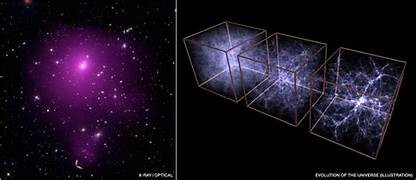
Small example of galaxies, attracted by gravity (Popular Assumption), coalesing into giant branches of a tree, from the Big Bang shown below:
Dark Matter is the invisible friend of all mainstream cosmologists: they know it’s there and it’s foundational to their understanding of the universe. A Nobel Prize and a day in the aura of Dan Campbell is out there for somebody if they can reveal something substantive about Dark Matter or account for motion in the universe in other ways.
C’mon, cosmologists, it’s not like it’s in a black hole or anything like that. I want an answer right after the Packer game.
**Microsoft’s topological quantum processor uses “ghost particles” that shouldn’t exist**
Microsoft team led by UC Santa Barbara physicists unveils first-of-its-kind topological qubit, paving the way for a more fault-tolerant quantum computer using Majorana particles – theoretical particles that are their own antiparticles and exist only at the edges of reality.
Majorana particles are quantum physics’ most mysterious entities. They’re particles that are identical to their own antiparticles, meaning they annihilate themselves. In Microsoft’s quantum processor, these “ghost particles” exist only at specific locations in superconducting materials, making them incredibly stable and resistant to the errors that plague other quantum computers.
Traditional quantum computers are incredibly fragile – even tiny vibrations or temperature changes can destroy quantum information. But topological qubits using Majorana particles are naturally protected by the laws of physics themselves. It’s like having quantum information stored in an unbreakable safe that only opens with the correct quantum key.
The eight-qubit Majorana 1 processor represents decades of theoretical physics becoming practical technology. While other quantum computers need complex error correction systems, topological qubits are inherently error-resistant. This could be the breakthrough that makes quantum computing reliable enough for everyday use, from solving climate models to cracking encryption.
Watch how the gubmint and giant corps retain access to our data by preventing that level of encryption from being available on our personal devices, for “security” reasons.
Most personal devices already have PQC implemented. Windows, Android, and Apple have already up to date with current NIST standards and will continue to be. I know Samsung also has incorporated PQC into their Galaxy products.
Most large corpos are way ahead of the curve on this stuff.