I guess it would depend on how dark the planets at the center of the galaxy get Here on earth we have to wait pretty much for full dark to get a good view of the night sky. If stars are closely concentrated, it may mean that planets only ever get to dusk level of darkness, making it more difficult to see the surrounding stars. It would definitely be interesting to find out how it all works there. As usual with space, there are many more questions than answers. That’s what makes it so interesting.
I would be curious about the increase in background radiation from the amount of stellar objects so much closer. well…‘closer’. but close to the center multiple stars under 1/2 a light year away good lord would those look bright at night. and being able to better ‘see’ Sagittarius A. Then again that much radiation we probably don’t exist like we do. Or at all.
1 Like
The tardigrades might be ok.
This sounds like characteristics of the HolySpirt.. just sayin’
1 Like
That monk has also studied Christianity and Buddhism as part of his training. He lived as a Christian acolyte as part of his training, same thing with Buddhism. He has a pretty universal view of world religions, though he is a devotee in the Advaita Vedanta tradition of Hinduism.
3 Likes
That’s awesome brother!!
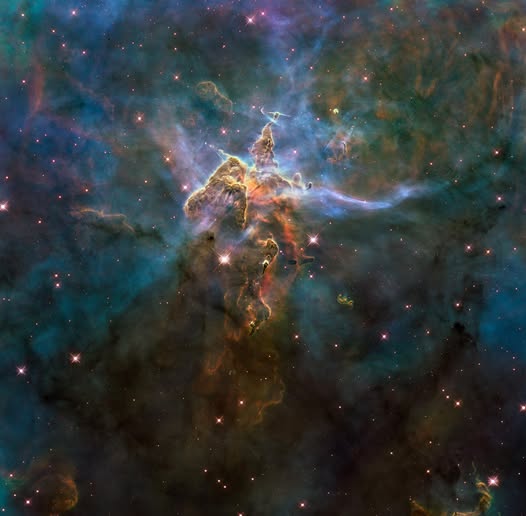
The Mystic Mountain towers within the Carina Nebula, a starbirth region about 7,500 light-years away.
This “mountain” is three light-years tall! Scorching radiation and fast winds from hot newborn stars in the nebula are shaping and compressing this pillar, causing new stars to form within it.
On International Mountain Day and every day, Hubble observes the universe from the ultimate mountaintop: space!
2 Likes
1 Like
3 light years across = about 18 trillion miles = about 750 million earths laid side by side. The gargantuan size of celestial bodies and space itself is mind boggling.
3 Likes
Leslie West was great.
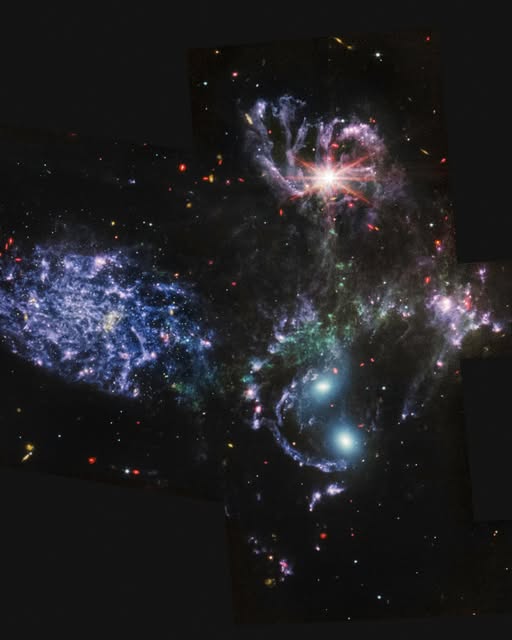
The mid-infrared instrument, a combined camera and spectrograph aboard the James Webb Space Telescope, shows never-before-seen details of Stephan’s Quintet, a visual grouping of five galaxies, providing insight into galaxy evolution in the early universe.
3 Likes
What a great photo. Breathtaking.
1 Like
A little mother earth cool news…
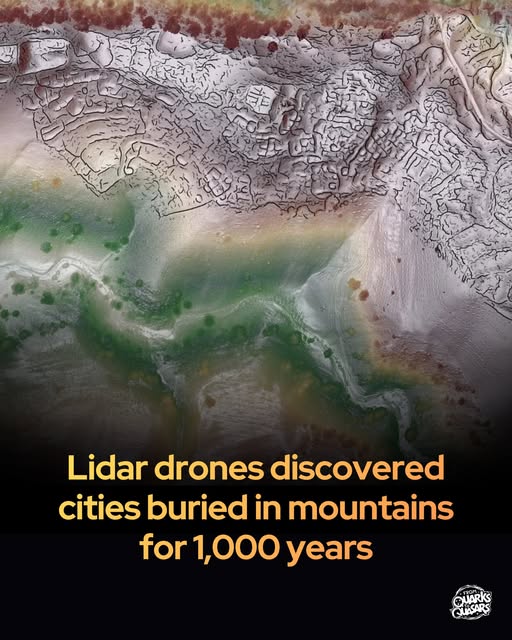
In a major archaeological breakthrough, researchers have uncovered two medieval cities hidden high in the mountains of Uzbekistan. Once thriving centers of trade, steel production, and politics, these Silk Road cities were rediscovered using drone-based lidar, a scanning technology that maps land contours through dense vegetation and soil.
Led by archaeologists Michael Frachetti (Washington University in St. Louis) and Farhod Maksudov (Uzbekistan’s National Center of Archaeology), the team mapped two settlements — Tashbulak and Tugunbulak — both perched at 6,500 feet (2,000 meters) above sea level. Until now, they were mostly invisible to the human eye.
What lidar revealed: a sprawling network of watchtowers, roads, plazas, and fortresses, with Tugunbulak spanning 300 acres (120 hectares). Over 300 structures were identified, including a citadel complex that may have served as a palace.
Radiocarbon dating places the cities’ peak between the 6th and 11th centuries.
Long assumed to be remote outposts, these cities challenge that narrative. They were hubs — active in metallurgy, rich in trade, and part of a highland Silk Road network that helped move power and resources across Eurasia.
So why did they vanish? Likely a mix of environmental degradation and political shifts. Over-harvested forests may have undermined fuel supplies needed for smelting iron.
Drone-lidar, once used to scan Mayan temples, is now reshaping what we know about Central Asia’s hidden cities — and what the Silk Road really looked like.
3 Likes
I hate the thought of having to climb up a 6500 foot mountain to trade my goats. They should’ve hired a market research firm before they put out their shingle. Location location location.
2 Likes
James Webb is the mind-blowing king, but archaeology and sociology are where my mind is at in the moment. The title sounds like shit talk, yet it is exactly what they deliver. It’s dense reading and concepts which are exceptionally well written to keep you on track.
The universe rocks, but so does the third rock from the sun.

5 Likes
If it’s what you love it really isn’t a job.
4 Likes
Sometimes what you love is not having your throat slashed by marauding pirates roaming across the plains. Nice goats, bra…
4 Likes
6500 feet up a mountain is pretty damn defensible, especially against hordes of horse mounted proto-Mongols
1 Like
Thanks for the tip. Just reserved it on my library app.
1 Like
Something tells me the mountain goat lovers might not be much better. It just comes at the end of a 6500 foot incline.