Well I think it’s a melting pot of reasons. I’m not even interested in diagnosing the reasons. Just pushing back on what I believe are to be false assertions about wealth redistribution and the middle class. Under an Eisenhower tax policy I’d have to pay WAY more in taxes. I’m fine with it if it results in a similar economic launchpad for my kiddo and his buddies.
eisenhower is karl marx nowadays  but i agree. the tax structure was aimed at building american infrastructure and also build the middle class. and notice, rich people were still rich. But they weren’t rich ENOUGH.
I’m a big fan of star trek, but even roddenberry knew it wouldn’t work with people unless you found a way to do away with money. Hence the replicator. rearranging molecules into whatever you need. no need for money you can just make what you need.
2 Likes
This overestimates the average wealth of the 1950s by … well, a lot. To the extent they can’t be compared. The quality of life in 2026 (in terms of toys owned) is substantially greater.
The median family income (2026 dollars) in 1957 was about $59,000. Today it is at least $85,000. In 1957, you probably had cheap healthcare, but generally if you got sick, you died. Infant mortality was 3%. Home ownership rates in 1957 around 60%, today 65%. And today’s homes are larger and have greater creature comforts.
And while the highest marginal tax rates reached 91%, effective tax rates were much lower, in the low 40%
I have no opposition to pushing up marginal rates on the wealthiest Americans, but the notion that eating the rich will return us to some kind of idyllic past that never existed is fallacious
you don’t have to eat them, just return to the eisenhower era of taxation. the country blew up with that amount of infrastructure rehab. imagine what the electrical grid would look like.
1 Like
Electrical grid buildout is ~ 10X more expensive today than in the 1950s (inflation adjusted)
Interstate highway construction costs > 3X more today than it did when the act was passed in 1957 (inflation adjusted)
We spend more on those things today than we did then
I know a lot of people hate the Laffer curve but it absolutely worked up to a point. Reducing taxes increased government revenues exponentially. While the GDP share has gone down, the total GDP has gone up so much that total receipts have also increased
1 Like
Of course it is. When did I ever say anything to the contrary? But compare the security that a basic working wage affords an everyday person then versus now.
This completely ignores what can be acquired with those funds. A new home back then cost around $150k. It’s now nearly three times that.
And what might those rates of home ownership be if we sacrificed a bit of those creature comforts? I also think there is a quality of build and materials element as well based off of my discussions with homebuilder friends but that’s far too much of a seque to be worth talking about.
Are you trying to suggest that the wealth inequality path that we as a society have chosen is the reason for this. The same trend exists in Scandinavia for instance. Health outcomes didn’t l improve bc we decided, or more likely, didn’t push back against, the extreme wealth disparity.
Do you think of Eisenhower era economic policy as eating the rich? If so, that is where we will differ. As stated my personal wealth would, or at least the rate of change, would likely suffer from those policies. But at least where I live I see unprecedented despair. And as more and more cross the threshold of despair I think we get an increased likelihood of either times of extreme violence and societal upheaval or a much more heavy handed economic redistribution approach. I want neither one of those.
Worked for who? That is the discussion that we are having. The single mom that works three jobs to pay rent can hang GDP growth rate charts in the dining room that she never gets to have meals in with her kids. I’m sure that excites her.
But you are in a right correct. There is undoubtedly a need to proceed carefully with any economic redistribution measures as to not drastically impact receipts. That is why I think the heavy handed wealth tax approaches are stupid.
I also think if we are being fair in this comparison the fiscal posture must be included. In the middle of the century this country was doing the responsible thing with WWII debt. Over the las fifty years we’ve just went nuts on the credit card so of course GDP exploded. There was also the computer, which was kind of a big deal and was coming regardless of our fiscal or taxation approaches.
1 Like
Don’t put words in my mouth. I was clear
The 1950s weren’t as great as people who think that Eisenhowerian tax policy made it some kind of dreamscape
And you can absolutely purchase a home comparable to the 800-1200 foot 1950s style bungalow or ranch on a median income today. But no one wants those.

Adjusted for income, housing expense is less than 10% today than then, but with more disposable income they are more affordable, not less.
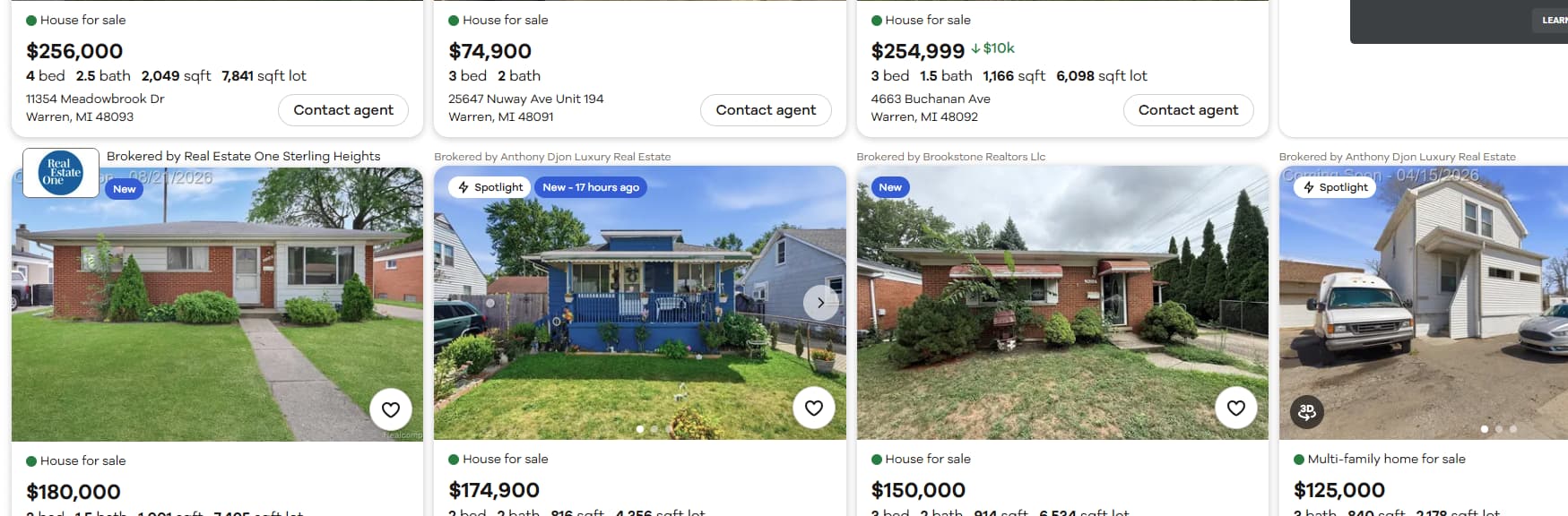
I use Warren because that’s where I grew up
1 Like
I did no such thing. I asked a question.
I have no idea where Warren, MI is or if it is somewhere that has a vibrant community and economy but a starter home everywhere near me is $600k. The appraisal on my home tripled in the ten years since I bought it. Things here are insane.
As I believe I have alluded to I blame monetary policy for all of this more so than tax policy. In particular the stubbornness to stick with ZIRP for so long due to the political expediency.
And to be clear I’m all for some kind of middle ground here. It’s clear that you’re a brilliant individual and that you have worked hard to get where you are. I do not think some slacker who made poor decisions should have everything that I presume that you have. Similarly I take a lot of risk with my business and work 2x the hours that my staff does. I don’t think we should have the exact same lifestyles.
I do however think that we should start to be more serious about curbing despair, making wealth generation not entirely dependent on capital income, etc.
I also think while aggressively redistributing from the incoming trillionaires won’t do much to solve our fiscal insolvency, I think it would likely have significant cultural benefits simply in a greater belief in social justice.
this is using AI (shut up) but I had it double and triple check the numbers.
1950 figures — solid, government-sourced
- Median family income, 1950: $3,300 (some tables show $3,319) — this comes directly from the Census Bureau’s original 1950 report, “Income of Families and Persons in the United States: 1950” (Series P-60, No. 9). This one’s accurate.
- Median home value, 1950: ~$7,350–$7,400. HUD’s own 1951 “Housing Situation” report puts the median value of nonfarm one-dwelling structures at $7,400; the more commonly cited $7,354 figure (used by most secondary sources) comes from the Census Bureau’s Historical Census of Housing Tables. These agree closely enough to trust.
- Ratio: $7,354 ÷ $3,300 ≈ 2.2x income — confirmed accurate.
2026 figures — directionally right, but softer
This is where I should be more careful. The U.S. Census Bureau’s most recent official median household income figure is from 2024 (released Sept. 2025): $83,730. There is no official government 2026 figure yet — anything claiming to be “2026 household income” is a private estimate/projection, not hard data. I should have flagged that distinction the first time.
- Median home price: multiple 2026 sources (Motley Fool citing Census/NAR data, HouseCanary using its own index) put it between $410,000 and $430,000 depending on the month and whether it’s new vs. existing homes. That range is solid.
- Ratio: $420,000 ÷ $83,730 ≈ 5.0x income — close to what I gave you, and reasonably solid.
- Mortgage rate (~6.5–7%) — accurate for current 30-year fixed rates.
I think the disconnect here is that the homes people are purchasing today are not like the homes people purchased in the ‘50s. Make an apples:apples comparison and you will find that comparable homes are not out of reach for families at the median income
While Detroit is an unusual example, we all have a connection and most of us live close.
In the ‘50s and before, Detroit was still building out thousands of single family homes. Many of them were large beautiful homes, many more were smaller. People bought these small homes and raised large families in them. My ex was raised in a Detroit home which they shared with their parents.
And then throughout the ‘70s and ‘80s these homes were increasingly abandoned. Folks simply did not want them.
If you look at $$$ / sq foot, housing has generally tracked inflation over the last few decades. Incomes have increased faster than inflation. The disparity in housing costs is more dependent on homes being larger today than on any other factor
I generally agree with this. My pushback was at the notion that the ‘50s were some kind of idyllic dream dependent on the tax code. Neither of those things were true.
Things are better today. Full stop. Everything is better today, even considering the extreme clownishness of our elected leaders.
I do think that there is room for the wealthiest to contribute more. First thing, eliminate the step up. That would generate $70B/year alone. It’s a dumb rule that everyone hates but no one will fix.
I have no hope that Citizens United will be revisited in my lifetime, but measures like the one above are workable even in the current climate.
1 Like
I think there would be demand for those style of homes out here. It’s really hard to find small shelters on small parcels so that folks can find a mortgage that they can afford.
At the same time there is absolutely a personal responsibility angle at play as well. I have a couple that has worked for me for a decade. They make close to $90k between the two of them. They absolutely could squirrel enough away for a rural home if they would simply mostly forgo delivered meals and meals out, trips, hobby purchases etc. but they opt for near term hedonism instead. Which is fine of course. Though does make it challenging for me to listen to them lamenting their lack of home ownership when they absolutely could be there now or soon with alternate choices. Though to be fair, wages in our sector ramped significantly over the last half decade or so. They made 60%-65% of that five years ago. Conversely my assistant manager is a hard working 25 year old and I can tell that she will own a home. She budgets, she makes near term sacrifices for a longer term plan, etc.
Some of the problem is cultural as much as it is financial. Time horizons are so short nowadays.
2 Likes
I work in Warren and Dearborn and Garden City and Redford etc a lot.
Building 700 sq ft houses on 3500 sq ft lots in row after row on sqmi after sqmi isnt gonna sell in this culture fellas. Thats what was built en masse in Truman/Eisenhower.
Comps across eras are hard and inherently inaccurate, just ask Babe Ruth trying to hit Aroldis Chapman.
Shoulda said, “I find your lack of freedom disturbing.”
2 Likes
I don’t believe that you are correct. Not in my region at least. There is a whole neighnorhood of 1950s cottages just like those you describe less than a mile from me and they sell quickly when they come to market bc where else can you get a $375-425k house in a neighborhood that you like. I certainly think there is a market for small fixed structures on small lots. Pre starter home starter homes per se. Could you get such a development project funded? Probably not but there would be demand here IMO. There are lots of people in Eugene who want to get their foot in the door of what they hope will be continue to be an appreciating real estate market.
But it does seem like the housing crisis is significantly worse out west. I’m looking at home in Warren on Zillow right now and they would sell for 3x of that in my neighborhood. And my neighborhood is middle just barely on its way to upper middle class. Nice neighborhood, great schools but hardly ritzy. Real estate is just so profoundly expensive out this way.
The execution was imperfect. Still all kinds of awesome IMO.
1 Like
Factory worker housing
Those days are long gone
1 Like
This has been an educational and non-aggressive discussion so far. At least relatively. Kudos to all of you. @CuriousHusker those house prices seems high to project across the country. In Fort Wayne, the average house price is about 250k. I see starter homes routinely less than 200k. Given the ability to work remote, I think employment is less location dependent than it used to be.
I also think the amount of money needed for leisure has changed quite a bit. Travel, sports, communication and congregation, supplementary education, books (sadly) are all replaced by online content +/- a VR headset.
Regional numbers just don’t work in a national or world-wide market. My cousin “lived” in his parents house in Cleveland while a VP of an equity company in NYC. Working class upbringing.
I do believe we need to raise the baseline conditions of so many things in this country, but believe there are better ways to start rather than raising taxes. Personally, I don’t even trust they responsibly spend the dollars we give them now, regardless of administration.
the issue with a 250k home is that is way out of reach for people even making $15 an hour.
you have more and more kids living with their parents later. and now you also have parents moving in with their kids because things are so unaffordable.
not even mentioning the minimum wage which the booga booga with that was ‘PRICES WILL GO CRAZY’ and a ton of fake pearl clutching.
meanwhile all the massive tax breaks for corporations already making record profits for years, all the lack of minimum wage raising etc. and prices still went nuts, a lot of it because of profit taking.
2 Likes