Why the 40 yard dash is unnecessary

I’ve made several posts in several threads about this before, but I thought it would be a really good idea to organize all of the discussion here.

So here’s the overarching question of what I expect to be a very good discussion.

Does the 40 yard dash, specifically at the NFL Scouting Combine, provide any indicator of future success, and is it important to have a good 40 time?

I say no. I’ve said no for a long time.

GPS based speed tracking, along with other methods of on field tracking methods are much more effective and efficient.

In recent years, there has been a great shift in training to a more analytical approach. For example: “We’re no longer going to train you to run 100 meters by having you jog a mile. We’re going to have you run 100 meters.”

Football is not an endurance based sport. Never has been and never will be. It’s about power and explosion, along with general athleticism to some degree.

NFL Strength and Conditioning programs have embraced this change, and are all looking for ways to more efficiently train their athletes. I’ve got a friend who works here in Huntsville who has been a strength coach in several power 5 strength programs and has major connections to a current NFL team’s staff who is backing up everything I am saying. He currently runs the strength program at a local high school and is implementing these new philosophies very well.

They don’t condition after football practice, before practice, or ever. The practice is the conditioning. They do a lot of speed based work and time using lasers and other methods for a variety of sprints and weight exercises.

Anyway, back to the topic of the thread.

The 40 yard dash is a non-football movement that is being asked of a football player. Teams are not drafting players to run 40’s, they are drafting them to play football.

Why did John Ross’s 4.22 40 not ever lead to anything?

Why aren’t football teams made up of olympic sprinters?

GPS timing is becoming a much more efficient way of tracking a football player’s speed that you can expect to see on the actual field.

For example, and I don’t mean to derail this thread, but Malik Willis clocked a 20.53 mph in the Senior Bowl.

Research has shown that in a football game, you are generally playing at about 70%-75% of your max speed in a 40 type enviornment, with some hitting as much as 85%, being your quarterbacks, running backs occasionally, and receivers and maybe even safeties.

Some math telms you that 20.53/0.85= ~24.15 mph in a 40 time, assuming everything goes right.

Tony Holler on Twitter is a great guy for sprinting and sprint coaching. Here is a chart he devised for converting 40 times to MPH…

Malik would have hit the high 4.2’s in a combine style 40. Pretty fast.

However, that’s obviously not any indicator of success.

New Next Gen stats from Amazon are also starting to track GPS times.

Here’s an article about it…

https://footballscoop.com/news/with-gps-chips-now-in-nfl-shoulder-pads-coaches-are-going-to-love-next-gen-replays

Also given that the combine 40 is a specific event that can be trained for for months, it drastically differs from the sudden, powerful, explosive movements in a football game.

Jordan Davis running a 4.78 or whatever means nothing about his NFL success. The game film shows that he moves ridiculously well for a guy that size, but maybe once in a season will he run 40 yards in a straight line. That’s also obviously not counting the pads and the track stance.

This isn’t the era of two-a-days and gassers and running 20 40’s and all. That only gets you tired. You get better at something by doing it, not by doing something else.

It’s better to judge someone’s football speed by how fast they are playing football, not how fast they run a 40 from a track stance.
5 Likes

Two words…Teez Tabor

5 Likes

I agree. I especially thought running the 40 was dumb for offensive lineman. It would make more sense to see how fast they could push the one man sled.

1 Like

This is a really cool post, thanks for putting this together @HSVLion. Great links.

Still gotta wrap my head around some of it, but I agree analytics has gotten so much better, player and draft analysis after the fact is going to take on a different look.

The only one thing I kind of sort of disagree with, and maybe I’m just not looking at it the same way, but saying football is not an endurance based sport. I mean, 4 quarters, yes you get breaks but that doesn’t account for an offense going 3 and out all the time, OL being out in 15 play drives… so I guess what I’m saying is there is some endurance measure there. Then again, football uses substitutions more than any other sport so I can definitely appreciate that perspective.

In regards to Teez Tabor @Sampson54, I would be interested in the other issues with his game or personality that prevented him from succeeding. Yes the 40 time sucked, but there had to be more to it than that.

5 Likes

An endurance based sport is cross country, or distance running, or soccer. I’d argue basketball could also be one but that’s different because you’re not pacing yourself as much.

Football is played with many powerful, explosive movements that are followed with periods of active recovery. Much different from really any other sport.

1 Like

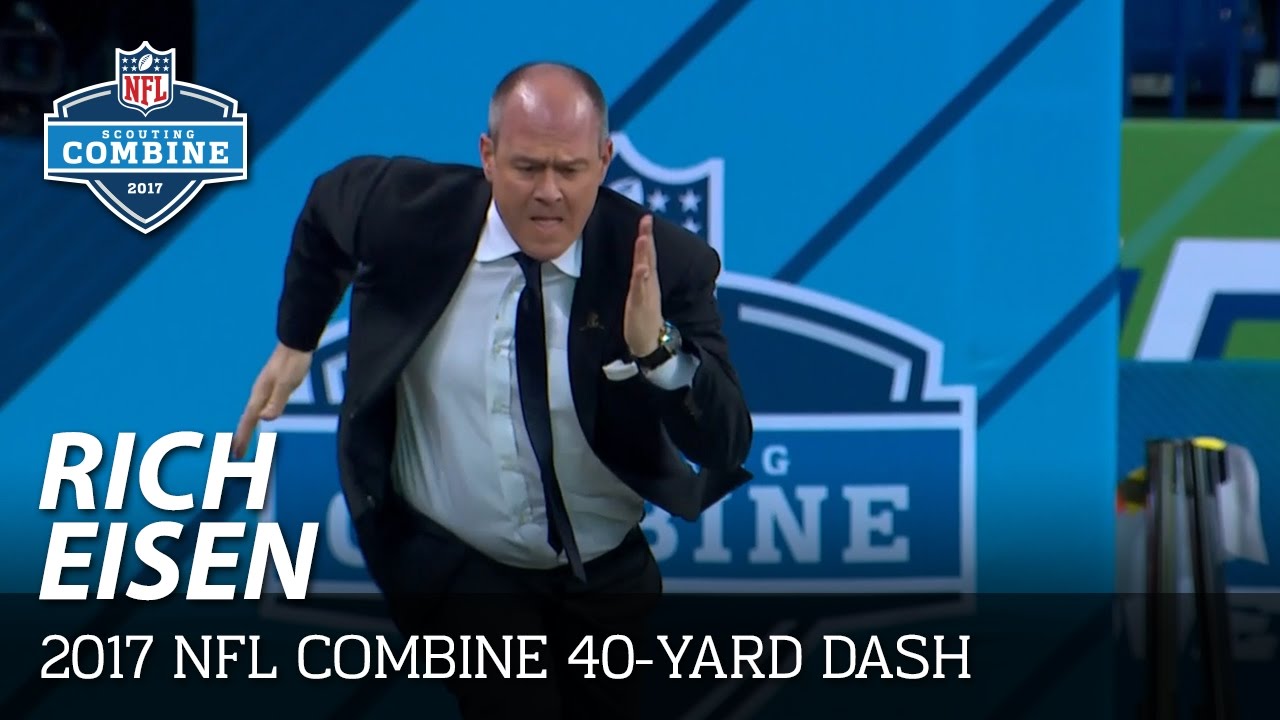
But I like to see Rich Eisen run the 40.

3 Likes

The 40 and many other things that are done at the combine are indicators of future failure. They are not supposed to be looked at as “bigger is better.” There is acceptable and unacceptable, and matching the film vs not matching the film.

Everything else is dreamed up by fans and chickenshit personnel departments.

1 Like

His 40 time was a gigantic red flag that 31 other teams saw.

It said A. He is to slow to play corner.
B. He didn’t put in the work to be prepared
for the combine. Which in its self is a
red flag.

The 40 is just a part of a tool to rate players. Im a fan of it. The gps is interesting and can be used for evaluation but not everybody is going to be able to show off their top speed in a game.

2 Likes

I’m not sure a bunch of GPS data from game situations would be all that useful. You’re not looking at peak athletic ability. You may determine that some players are putting out near peak athletic ability often. But is that a good thing? Mike McMahon would probably show that kind of behavior. He runs fast a lot of the time. That’s good right? Or is that chicken with a head cutoff and it really wasn’t all that good? Just watch the film, there is no substitute. The combine works just fine to measure things like how fast you can run in a line and how high you can jump.

I disagree, you want mobile QB’s , they have to have the ability to evade, run and get separation and be agile enough to make tacklers miss-to, get extra yards and/or score. Corners have to be able, to mirror ,to track down, to outrun, their targets OR put themselves in place to make plays and-or intercept the footballs. point C: WR’s & TE’s, the whole point is them being able to get separation, to run away, to run crisp routes fluidly…to be shifty and get yards after the catch. RB’s are almost entirely picked based off how fast they are, how powerful of runners they are, can they make people miss, can they beat their defenders to the ball and make plays, can they catch, or block. yet SPEED is their game. LB’s …you want them to get to the QB or catch a RB, a WR, a TE or a CB and make defensive plays, even put themselves into a position to make plays on the football,…that comes down to power, speed, common sense, and intelligence and reading the QB or plays…you can’t do that if your slow.

While I completely agree with the overall premise that unless it’s a huge outlier, the 40 basically means nothing to NFL success, I’m not sure I understand your process.

You’re saying you can take those MPH numbers, which I agree are far more important, and use them to extrapolate a 40 time (as you’ve done with Malik Willis). But if that were the case then the 40 WOULD matter, because we could take the 40 time and extrapolate a MPH number.

The reason I think the 40 doesn’t matter and the MPH does is because they DON’T correlate (i.e., you can’t extrapolate a MPH based upon a 40 time or vice versa). Which is how a fast MPH guy like Cooper Kupp runs a 4.6+, or Daniel Jones runs a 4.8 and yet ran the fastest MPH time of any QB in the league back in 2020. “Football speed” or “speed in pads” is faster than their timed 40, which we’ve pretty much always known but haven’t had a reliable way to test until recently.

The fastest mph ever recorded in a game was 23.24 by Tyreek Hill. According to that chart and your math, that means he would run at 27.34mph in 40 time. That’s far above the chart but based on the differences between the numbers on the chart, he would have run about a 3.8 40, which is obviously ridiculous. But even if you threw out the chart and the numbers, the fastest player of all time in mph ran a 4.33, I don’t see any way Willis could be predicted to run faster. That mph time of 20.53 is slower than Jones (21.01), who ran a 4.8.

I also agree with Willis that it’s irrelevant what he runs. We know he’s fast af, that’s all that really matters. It’s a +++ trait coming into the league. The difference between 4.3 and 4.6 at QB is negligible.

3 Likes

I agree with everything in your post. What I’m saying is that the 40 is a bad method to measuring that speed, not that it doesn’t matter.

So again, how I do that uses what is currently an unmeasurable statistic which is the individual rate of translation from football speed to a 40 time. The average for top speed in a game is around 85%, but that number is by no means uniform to everyone.

I’ll ask that strength coach more about how that is determined and get back to you.

Well given that Usain Bolt ran a 4.22 40 at some NFL event before and that his top speed ever is 27.33 mph, that’s totally feasible.

then why say it’s absolutely unnecessary , if the 40 is a bad method of measuring speed? I disagree with that as well.

120 foot to get from point A to point B…what’s wrong with that? because their not in full gear?

Because they’re not in full gear, because rarely in a game does a player fun 120 feet in a straight line at full intensity, and because the translation from football to 40 speed isn’t uniform.

Measuring game speed is a much more efficient method of seeing how well a guy gets from point A to point B.

not necessary. But useful

Ok, so if the 40 time isn’t indicative of NFL success, which event is?
Let me help you out here.

There’s no one drill or measurable that is indicative of success in the NFL. So why do any then?
The drills that are done help to evaluate a player. You watch the tape and then you compare to the measurables to see if they line-up, if they don’t line-up then you figure out why and if it’s something you are willing to live with or you think is something that doesn’t matter.

So, to answer your question, yes the 40 can be useful.
No it does not mean that a guy is going to be successful in the NFL, none of the drills do.

If you don’t think a 40 time is important, then why did you say that Willis supposedly ran in the 4.2’s?

Ok @Thats2 and @Snags, I have your answers.

I cannot say that Malik Willis would run a 4.28 40 yard dash. There isn’t enough or really any science to make my estimation correct.

That however, as an estimation using scientific averages, is what numbers say he would have ran.

Again, the numbers are not perfect. It is currently impossible to measure how much intensity someone specifically runs in football compared to a stock 40 time.

The 85% number is not uniform. It never will be. When Tyreek Hill ran a 23.24 mph in a game, he was pushing 100%. Same with Daniel Jones when he ran a 21.

That 85% is an average derived by NFL statistics about average mph data and factoring in different positions. I didn’t get a link to this because it would be linked here.

It is impossible to calculate what percentage of max effort Malik was running when he hit 20.53. Because of this, it is illogical to claim that he “would run” a 4.28 or that kind of range in a 40.

You also would assume that the 40 is being ran at max intensity and without any errors, like a bad start or a false step, in any of these calculations.

Can an NFL team try and make evaluations based on a 40? They probably know how little value it has, but they certainly can. I wouldn’t personally.

The hope is to measure a player’s raw athleticism. I think a vertical and broad jump are great tools to measure a player’s explosiveness, which is very important in football. Also, all of the field work stuff is very good for evaluation. How well does a guy move making football movements? Sure he doesn’t have pads on, but that’s a lot better than the 40 or a bench press.

You could have the guy running the 40 wearing a GPS jacket. But there is no point. When I instrument a car with GPS, I’m measuring things like yaw, roll, pitch, etc. None of which you need if you just want to measure linear speed. The 40 is far superior to these stupid game measurements with GPS jackets that aren’t standardized or controlled and have zero value as a scientific test.

But football is not a standardized or controlled game. The whole point of why gps is better is because it measures what you actually want, which is football speed. Football is not played linear.

Again, if it mattered to be faster at a 40 than playing football, why aren’t olympic sprinters all on NFL rosters? They’re far superior in running in a straight line.

1 Like